

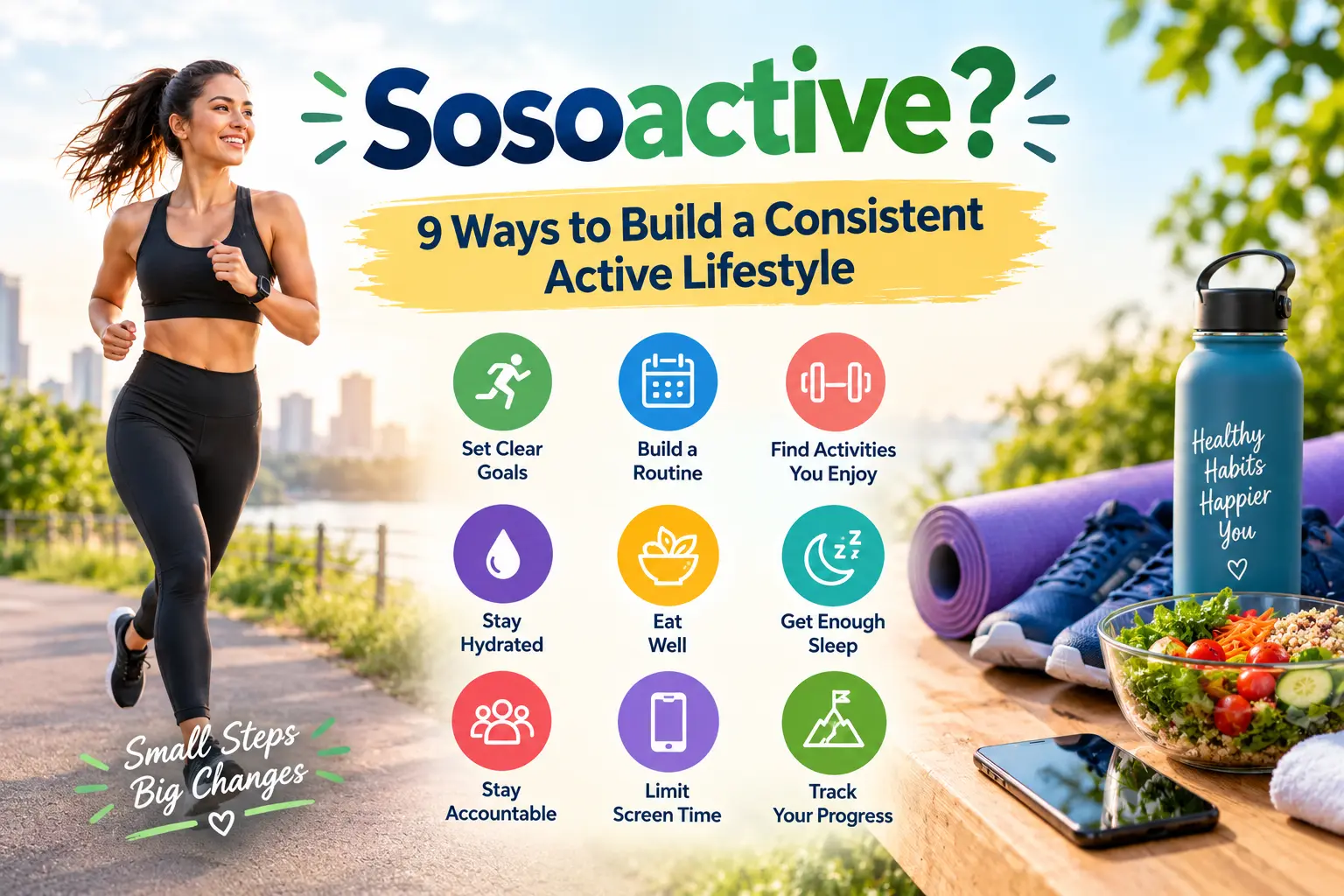
You walk to the shop sometimes. You went to the gym three times in March. You took the stairs yesterday, but you also sat for nine hours straight today. If that sounds familiar, you are probably sosoactive: not a couch potato, not an athlete, just stuck somewhere in the middle. If you have been searching for how to be more active without a punishing overhaul of your life, this guide is for you.
The good news is that being sosoactive is not a failure. It is the most common place to start. Most adults move a little, in bursts, depending on mood, weather and workload. The challenge is turning those unpredictable bursts into a steady rhythm that improves your energy, mood, sleep and long-term health.
In this guide you will learn what the sosoactive state really is, what the research says about how much movement your body needs, and nine practical, realistic ways to move from “so-so” to consistently active. You will get a simple weekly structure, a beginner exercise routine you can do at home, strategies for the days when motivation disappears, and a four-week plan you can start today.
What Does “Sosoactive” Mean? (And Why It’s So Common)
Let’s define the term plainly, because clear definitions help you recognise where you stand.
Sosoactive (adj.): moving some, but not consistently or intentionally enough to reach recommended activity levels, or to feel the full benefits of regular exercise.
A sosoactive person might look like this:
- Works out in short streaks of two or three weeks, then stops for a month.
- Walks regularly on some days but is completely sedentary on others, especially workdays.
- Feels guilty about not exercising enough but also feels “too busy” or “not fit enough” to start properly.
- Does not track activity and is not sure whether they are doing “enough.”
- Alternates between all-or-nothing plans and doing nothing at all.
If you recognise yourself, you are in large company. Global health agencies have repeatedly reported that a large share of adults do not meet recommended physical activity levels. Modern life is built around sitting: desk jobs, commuting by car, screen-based leisure and food delivered to the door. Movement, which used to be a natural by-product of daily life, now has to be added on purpose.
So why does this middle zone matter? Because it is where small, smart changes produce the biggest return. Going from zero activity to some activity is the single most beneficial step for health. Going from sosoactive to consistently active is the second step, and it is far more achievable than most people believe.
The “so-so” trap: why moderate effort without structure stalls
People in the sosoactive zone often fall into three traps:
- The motivation trap: They wait to feel like exercising. Motivation is unreliable, so activity depends on mood.
- The all-or-nothing trap: If they cannot do a full 60-minute session, they skip it entirely.
- The invisible-progress trap: Without a simple way to measure movement, there is no feedback, and no feedback means no momentum.
The nine strategies below are designed to dismantle each of these traps, one at a time.
Why Being Sosoactive Isn’t Enough: What the Evidence Says
Before building a plan, it helps to know the target. Health guidance gives a useful benchmark without demanding perfection.
The 150-minute guideline
The World Health Organization recommends that adults aged 18 to 64 aim for at least 150 to 300 minutes of moderate-intensity aerobic activity per week, or 75 to 150 minutes of vigorous activity, or an equivalent mix. It also recommends muscle-strengthening activities on two or more days per week. Many national health bodies, including those in the United States and the United Kingdom, publish very similar targets.
The 150 minutes of exercise per week figure sounds large, but it breaks down to about 21 minutes a day, or five 30-minute sessions. “Moderate intensity” means you can talk but not sing, such as brisk walking, easy cycling or gentle swimming.
Sitting is a separate problem
Research also suggests that long, uninterrupted sitting carries its own risks, independent of exercise. A well-known analysis published in The Lancet in 2016 found that the higher mortality risk linked with very high sitting time was greatly reduced, and in some cases eliminated, among people who did around an hour of moderate activity per day. In other words, you can offset much of the harm of a sedentary lifestyle, but only if you actually move.
This is why “I went to the gym this morning” does not fully solve the problem if the remaining ten hours are spent in a chair. The most resilient approach combines planned exercise with more general movement spread through the day.
You don’t need 10,000 steps
The famous 10,000-step target began as a marketing slogan for a Japanese pedometer in the 1960s, not as a scientific finding. Later research gives a more nuanced and encouraging picture. A large 2022 meta-analysis in The Lancet Public Health found that the risk of death declined as daily steps increased, with benefits continuing up to roughly 6,000 to 8,000 steps a day for adults aged 60 and over, and about 8,000 to 10,000 for younger adults. An earlier study of older women found that averaging around 4,400 steps a day was associated with a significantly lower mortality rate than about 2,700 steps a day.
The takeaway for the sosoactive person: every additional bit of movement counts, and you do not need to hit an arbitrary number to benefit.
Short bursts count too
In 2022, a study in Nature Medicine using wearable-device data suggested that people who did very short bouts of vigorous activity during daily life, around three one-minute bursts per day such as hurrying up stairs or a brisk uphill walk, had a notably lower risk of death over the following years than people who did none. The study was observational, so it cannot prove cause and effect, but it supports a practical message: small efforts add up.
What regular activity does for you
Beyond longevity, consistent movement is linked with:
- Better mood and lower rates of depression and anxiety symptoms
- Improved sleep quality
- Better blood sugar control and heart health
- Stronger muscles and bones, and better balance as you age
- Sharper focus and, in many people, steadier daily energy
None of this requires becoming an athlete. It requires becoming reliably active, and that is a skill you can learn.
Way 1: Audit Your Week and Find Your True Baseline
You cannot improve what you have not noticed. Most sosoactive people are surprised when they honestly measure their activity, usually in one of two ways: they discover they move less than they thought, or more than they gave themselves credit for. Both discoveries are useful.
How to run a simple 7-day movement audit
For one normal week, do not change anything. Just observe. You can use a phone’s built-in step counter, a smartwatch, or even a notes app.
Record, each evening:
- Steps or active minutes: Use whatever your device shows.
- Sitting blocks: Roughly how many hours you sat without a break longer than 30 minutes.
- Planned exercise: Anything deliberate: a workout, a long walk, a sports session.
- Energy level: Rate your energy from 1 to 5 in the afternoon.
After seven days, look for patterns:
- Which days are most active, and why? (Maybe a day with a commute on foot, or a weekly sports night.)
- Which days are the lowest? (Often the busiest workdays.)
- Do your energy ratings rise on more active days? Many people notice a link.
Why this step matters
The audit turns a vague feeling (“I should move more”) into specific information (“On Tuesdays and Wednesdays I take under 2,000 steps and sit for nine hours”). Specific problems have specific solutions. It also gives you a starting number to beat, which makes progress visible, the antidote to the invisible-progress trap.
Tip: Do not judge yourself during the audit. This is data collection, not a performance review.
Way 2: Create a “Minimum Viable Routine” You Can Always Keep
Here is the most important idea in this guide: consistency beats intensity.
Sosoactive people often plan ambitious routines, such as five gym sessions a week, and then abandon them the first time life gets busy. A better strategy is to define a minimum viable routine: the smallest amount of activity you are confident you can do even on your worst week.
Build your minimum around real life
Ask yourself: “What could I do on a day when I’m exhausted, busy and unmotivated?”
For many people the answer is something like:
- A 10-minute walk after lunch or dinner
- Five minutes of stretching or mobility work
- One short strength circuit (see Way 5)
This is your floor, not your ceiling. On better days you will do more. But on difficult days, you still do your minimum, and your habit survives.
The weekly framework
Here is a simple structure that works for most adults. Adjust the details to your life.
| Day type | What you do | Time |
|---|---|---|
| 3 “Anchor” days | Planned 30-minute brisk walk, cycle or workout | 30 min |
| 2 “Strength” days | Beginner bodyweight circuit | 20 min |
| 2 “Minimum” days | 10-minute walk plus light stretching | 10-15 min |
Total: roughly 130 to 170 minutes of deliberate movement per week, which is in the zone of the 150-minute guideline, before counting any extra daily walking.
Use the “never miss twice” rule
Everyone misses days. What separates consistent people from sosoactive ones is what happens next. Adopt this rule: you can miss one day, but never two in a row. A single missed session is an accident. Two is the start of a new habit, and not the one you want.
Make it fit your identity, not just your calendar
Researchers who study habits often point out that behaviour sticks when it matches how you see yourself. Instead of “I’m trying to exercise more,” try “I’m someone who moves every day.” A small daily action, however minor, keeps that identity true, and each repetition strengthens it.
Way 3: Increase Daily Activity Through Everyday Movement
Exercise sessions are only part of the picture. Scientists use the term NEAT, short for non-exercise activity thermogenesis, to describe the energy you spend on everything that is not sleeping, eating or deliberate exercise: walking to the printer, doing housework, fidgeting, standing, gardening, carrying shopping.
For someone with a desk job, NEAT can be the difference between a 1,500-step day and a 7,000-step day. Learning to increase daily activity through ordinary habits is one of the most sustainable strategies for a sosoactive person, because it needs no gym, no kit and no extra time.
15 daily movement habits that fit into a normal day
Pick two or three to start. Adding too many at once defeats the purpose.
- Walk during phone calls: Any call that doesn’t require a screen can be a walking call.
- Take a “walking meeting:” Suggest one for one-to-one catch-ups.
- Use the farther parking space or get off the bus one stop earlier.
- Take the stairs for one to three floors, every time.
- Stand up every 30 to 45 minutes: Set a gentle timer. Even 60 seconds of standing and stretching breaks up long sitting.
- Drink water and refill often: A bigger glass means more trips to refill. A small, helpful side effect.
- Do a 10-minute walk after meals: Short post-meal walks are associated with better blood sugar responses and are easy to remember.
- Do household tasks with intent: Vacuuming, gardening and carrying laundry up and down stairs all count.
- Stand while you watch TV ads or while on hold: Turn passive minutes into active ones.
- Keep resistance bands or light dumbbells near where you spend time, so a few reps are easy.
- Walk to nearby errands instead of driving when practical and safe.
- Play actively with kids, pets or friends: Social movement is the least “exercise-like” and often the most enjoyable.
- Try a standing or adjustable desk if you work from a desk, alternating positions.
- Do a two-minute reset between tasks: shoulder rolls, squats, calf raises.
- Schedule a daily “movement appointment” in your calendar, even a ten-minute one, and treat it like a meeting.
Pair new habits with existing ones
Habit researchers recommend “habit stacking”: attaching a new behaviour to something you already do automatically. For example:
- After I pour my morning coffee, I do two minutes of stretching.
- After I finish lunch, I walk for ten minutes.
- After I brush my teeth at night, I do ten squats.
The existing habit becomes a built-in reminder, and you no longer rely on remembering or on motivation.
A realistic example
Imagine Priya, a software analyst who works remotely. Her audit shows she averages 2,300 steps on workdays and sits roughly nine hours a day. She picks three daily movement habits: a ten-minute walk after lunch, standing for all phone calls, and a five-minute stretch after her morning coffee. Within two weeks her workday average rises past 5,000 steps without a single “workout.” She did not add an hour to her day. She redistributed small pieces of movement into time she already had.
[Author tip: replace Priya’s example with a real client story, personal experience or case study from your own work. First-hand experience is a key quality signal for Google’s E-E-A-T guidelines.]
Way 4: Use Walking for Fitness as Your Foundation
If there is one activity worth building your routine around, it is walking. It is free, low-impact, adjustable and available to almost everyone. For a sosoactive beginner, walking for fitness often provides the best return on effort, and it is far easier to sustain than most gym programmes.
Why walking works so well
- Low barrier: No equipment, membership or special skill.
- Low injury risk: Compared with running or high-impact sports, walking is gentle on joints.
- Scalable: You can adjust pace, distance, terrain and duration as you improve.
- Mentally restorative: Time outdoors and away from screens often improves mood and creativity.
- Easy to socialise: Walking with a friend or group improves accountability.
How to make a walk “count” as moderate exercise
A stroll is better than nothing, but to reach the moderate-intensity guideline, aim for the talk test:
- Too easy: You can sing. Pick up the pace.
- Moderate: You can talk in full sentences but feel slightly breathless. This is the target.
- Vigorous: You can only say a few words at a time. This is a higher effort, useful in short intervals.
A brisk walking pace for many adults is around 100 steps per minute, though this varies with height, fitness and age. Use the talk test rather than obsessing over the number.
Four simple ways to progress your walking
- Add time. Increase your walk by five minutes every week or two.
- Add intervals. Alternate two minutes of faster walking with two minutes of easy walking.
- Add hills or stairs. Slopes raise intensity without extra speed.
- Add a purpose. Walk to a destination you enjoy, such as a park, café or market, so the walk has a reward built in.
A sample 4-week walking build
| Week | Goal |
|---|---|
| Week 1 | 3 walks of 15 minutes at an easy-to-moderate pace |
| Week 2 | 4 walks of 20 minutes, with two brisk blocks of 3 minutes each |
| Week 3 | 4 walks of 25 minutes, with intervals of 2 minutes brisk / 2 minutes easy |
| Week 4 | 5 walks of 25 to 30 minutes, including one hilly or longer route |
By the end of the month, you are comfortably near 150 minutes of weekly activity from walking alone.
Make walking safe and comfortable
- Wear supportive, comfortable shoes.
- Dress for the weather and choose well-lit, familiar routes, especially in the evening.
- Carry water on longer walks.
- If walking outdoors is difficult because of weather or safety, use a treadmill, an indoor track, a mall or a stairwell.
Way 5: Start a Beginner Exercise Routine at Home (Strength Included)
Walking and daily movement build your aerobic base and break up sitting. But a well-rounded plan also includes muscle-strengthening. The WHO recommends strength work at least twice a week, and for good reason. Muscle supports your joints, protects bone density, improves balance and helps regulate blood sugar. It becomes even more important as you age.
The good news: you don’t need a gym. Home workouts for beginners can be effective with just your bodyweight and a chair.
The 20-minute full-body starter circuit
Do this twice a week, on non-consecutive days. Perform each exercise for 40 seconds, rest for 20 seconds, and complete the full circuit twice. Rest for two minutes between rounds.
| Exercise | Muscles worked | Easier option | Harder option |
|---|---|---|---|
| Chair squat (sit down and stand up) | Thighs, glutes | Use hands for support | Hold a bag of books at your chest |
| Wall or incline push-up | Chest, shoulders, arms | Stand farther from the wall | Do push-ups on the floor from knees or toes |
| Glute bridge | Glutes, hamstrings, core | Smaller range of motion | Single-leg bridge |
| Bent-over “row” with a backpack or water bottles | Upper back, arms | Lighter weight | Heavier weight, slower tempo |
| Standing calf raise | Calves, ankles | Hold a wall | Single-leg raise |
| Dead bug or bird dog | Core, stability | Smaller movements | Slower pace, longer hold |
Technique principles for beginners
- Move slowly and with control: Quality beats speed.
- Breathe steadily: Exhale on the effort, inhale on the easier part.
- Aim for effort, not pain: Muscle fatigue is normal. Sharp or joint pain is a signal to stop and adjust.
- Progress gradually: When an exercise feels easy for two sessions, make it slightly harder with more reps, a slower tempo or a bit of extra weight.
Warm up and cool down
Spend three to five minutes before each session warming up: marching on the spot, arm circles, hip circles and a few bodyweight squats. After, spend a few minutes on gentle stretches for the calves, thighs, chest and back. A warm-up prepares your joints, and a cool-down helps your heart rate return to normal.
If you prefer a gym, class or app
Home routines are not the only option. If you like structure and social energy, group classes, community fitness sessions, yoga, Pilates, swimming or a beginner-friendly gym programme work just as well. The best exercise is the one you will actually keep doing. Choose what you enjoy enough to repeat.
Way 6: Build an Exercise Habit With Behaviour Science
Knowing what to do is rarely the problem for a sosoactive person. The challenge is doing it repeatedly. To build an exercise habit that lasts, it helps to understand how habits actually form.
Habits take longer than you think, and that’s fine
A widely cited study from University College London, published in 2009, followed volunteers adopting a new daily behaviour. It found it took an average of about 66 days for the behaviour to feel automatic, but the range was huge, from 18 days to 254 days. The lesson: if a new routine still feels like effort after three weeks, nothing is wrong with you. Automaticity simply takes time, and missing the occasional day did not derail habit formation in that research.
The four-part habit loop
Most habit frameworks describe a similar cycle:
- Cue: a trigger that prompts the behaviour (a time, place, or preceding action).
- Craving: the motivation or desire attached to it.
- Response: the action itself.
- Reward: the positive feeling or outcome that makes you want to repeat it.
To design a habit that works, deliberately build each part.
- Cue: Choose a specific time and place. “I’ll walk at 6:30 pm after I close my laptop” beats “I’ll walk sometime this evening.”
- Craving: Pair the activity with something you enjoy: a favourite podcast, music, or a friend.
- Response: Make it easy. Lay out your shoes the night before. Keep your workout clothes visible.
- Reward: Give yourself an immediate, satisfying finish: tick a calendar box, enjoy a good shower, make a favourite drink.
Use implementation intentions
Psychologists have found that people are much more likely to follow through when they plan the “when, where, and how” in advance, using an if-then statement. For example:
- If it is Monday, Wednesday or Friday at 7 am, then I will walk for 25 minutes before breakfast.
- If it is raining, then I will do my 20-minute home circuit instead.
The second statement is especially powerful. It pre-solves the obstacle, so the weather no longer decides whether you move.
Reduce friction, add friction
Behaviour follows the path of least resistance. Make good habits easier and unhelpful ones slightly harder:
- Keep a pair of walking shoes by the door.
- Put a yoga mat or resistance band where you will see it.
- Plan your route or workout in advance, so there is no decision to make.
- Move your phone charger away from the sofa, so you are not tempted to stay glued to a screen all evening.
Track in the simplest possible way
A wall calendar with an X for each active day creates a visible chain you will not want to break. Many people find that a simple visual record is more motivating than a complicated app. If you prefer digital tracking, a step counter or habit app works too. Choose whichever you will actually look at.
Find accountability and community
Social commitment is one of the most reliable motivators. Try:
- A walking buddy with a fixed weekly time
- A local running, walking or fitness group
- A friendly competition or shared step challenge with colleagues or family
- Telling one supportive person your weekly plan and checking in on Sunday
When another person is expecting you, you show up on days when your own willpower would not.
Way 7: Try “Exercise Snacks” When Time Is Tight
“I don’t have time” is the most common reason sosoactive people give for skipping exercise. Exercise snacks are a practical answer: very short bouts of activity, typically one to five minutes, scattered through the day.
What are exercise snacks?
The term describes brief, purposeful movement breaks such as:
- 1 minute of brisk stair climbing
- 10 to 20 bodyweight squats while the kettle boils
- 30 seconds of fast marching or jumping jacks between meetings
- A 2-minute fast walk around the block
- 10 wall push-ups after finishing a task
Early research on short bursts of vigorous activity, including the 2022 Nature Medicine study mentioned earlier and several small trials on stair-climbing, suggests that even brief efforts spread through the day can improve fitness measures. More evidence is still being gathered, and these studies do not mean snacks fully replace regular exercise, but they are a strong option when a full session isn’t possible.
A sample “snack” day
| Time | Snack | Duration |
|---|---|---|
| Morning | Squats and calf raises while the coffee brews | 2 min |
| Late morning | Stair climb or brisk lap of the office | 2 min |
| Lunch | Brisk walk to collect lunch | 10 min |
| Mid-afternoon | Wall push-ups and shoulder rolls | 2 min |
| Evening | Walk after dinner | 15 min |
Total: about 30 minutes of movement, none of which needed a gym, a shower or a change of clothes.
Safety and common sense
If you are new to vigorous effort, start gently. Increase intensity gradually, warm up your joints with a few easy movements, and stop if you feel chest pain, dizziness or unusual shortness of breath. Seek medical advice first if you have heart, blood pressure or joint concerns.
Way 8: Plan for Obstacles Before They Appear
The sosoactive pattern usually isn’t caused by laziness. It is caused by predictable obstacles that nobody planned for. Identify yours and write a response in advance.
Obstacle 1: “I don’t have time”
Reframe: You don’t need an hour. Use your minimum viable routine and exercise snacks. Look at your 7-day audit: where are the easiest ten-minute gaps?
Action: Schedule movement like an appointment, and attach it to a fixed point in your day, such as right after school drop-off or right after your last meeting.
Obstacle 2: “I’m too tired”
Reframe: Fatigue is often mental rather than physical, and gentle movement frequently raises energy rather than draining it. Many people find a ten-minute walk is more refreshing than a nap.
Action: Make a deal with yourself: “I’ll start for five minutes. If I still want to stop, I can.” Most of the time, starting is the hardest part, and you will keep going. If you are persistently exhausted, check your sleep and consider speaking with a doctor.
Obstacle 3: “I’m not motivated”
Reframe: Motivation often follows action, not the other way around. Waiting to feel ready is a losing strategy.
Action: Rely on cues, routines and commitments, not feelings. Pick activities you enjoy: dancing, hiking, cycling, swimming, gardening, team sports. If you dread it, you won’t repeat it.
Obstacle 4: “Bad weather or no safe place to walk”
Action: Build a rainy-day plan: a home circuit, a YouTube or app-guided class, stair walking, mall walking, or a swim. Your if-then plan (Way 6) handles this in advance.
Obstacle 5: “I get bored or plateau”
Action: Change one variable every three to four weeks: route, music, workout partner, time of day, or add a new activity. Variety keeps both body and mind engaged.
Obstacle 6: “I feel self-conscious or intimidated”
Action: Start at home, or choose beginner-friendly classes and outdoor spaces. Remember that most people at a gym or park are focused on their own routine. Walking groups and beginner classes are usually welcoming environments.
Obstacle 7: “I have pain or an injury”
Action: Don’t push through sharp or persistent pain. See a doctor or physiotherapist, and ask which movements are safe. Often there are alternatives, such as swimming, cycling or upper-body work, that keep you active while an area heals.
Way 9: Track Progress, Recover Well, and Progress Gradually
Once your routine is running, the last piece is sustaining it over months without injury or burnout.
Track what matters
Useful, simple metrics for a sosoactive person moving toward consistency:
- Active days per week (aim for five or more, with some of those being “minimum” days)
- Total weekly minutes of moderate activity, working toward 150
- Average daily steps, compared with your starting baseline
- How you feel: energy, mood, sleep, and how easy everyday tasks feel
Non-scale indicators of progress often matter more than numbers: climbing stairs without getting winded, carrying shopping more easily, sleeping better, or feeling calmer after a stressful day.
Progress gradually
A common guideline is to increase total activity by no more than about 10 percent per week. If you added three 20-minute walks this week, aim for a modest increase next week rather than doubling your effort. Overreaching is a major reason people get injured and quit.
Prioritise recovery
Recovery is part of training, not a break from it.
- Sleep: Most adults need around seven to nine hours. Poor sleep makes exercise feel harder and reduces motivation.
- Rest days: Include at least one or two lighter days each week. Gentle walks and stretching count as active recovery.
- Hydration and nutrition: Drink water throughout the day and eat balanced meals with enough protein, fibre and carbohydrates to fuel your activity. For personalised nutrition advice, consult a registered dietitian.
- Stress management: High stress can drain energy. Walking, yoga, breathing exercises or time with friends all support recovery.
Celebrate consistency, not perfection
After a good week, acknowledge it. Treat yourself to something that fits your goals: a new playlist, a good meal, a weekend adventure. Positive reinforcement strengthens the habit loop.
Your 4-Week Plan to Stop Being Sosoactive
Here is a simple, flexible schedule that combines everything above. Adjust it for your fitness level, schedule and health.
| Week 1: Foundation | Week 2: Build | Week 3: Strengthen | Week 4: Lock it in | |
|---|---|---|---|---|
| Daily | 7-day baseline audit continues; pick 2 daily movement habits | Add a third daily habit; stand every 45 minutes | Aim for 1,000 more steps than baseline | Aim for 2,000 more steps than baseline |
| Walking | 3 walks x 15 min | 4 walks x 20 min | 4 walks x 25 min with intervals | 5 walks x 25-30 min |
| Strength | 1 session (learn the moves) | 2 sessions | 2 sessions, slightly harder | 2 sessions, add reps or weight |
| Snacks | 1 per day | 2 per day | 2-3 per day | 2-3 per day |
| Review | Sunday: note what felt easy and hard | Sunday: adjust times and routes | Sunday: celebrate and set next goal | Sunday: choose your next 4-week focus |
By the end of week four, you should be near or at the 150-minute target, have a repeatable weekly routine, and feel noticeably more in control of your activity levels.
7 Common Mistakes Sosoactive People Make (and Fixes)
- Starting too big: Fix: begin with your minimum viable routine and build from there.
- Relying on motivation: Fix: use cues, calendars and commitments instead.
- Doing only one type of activity: Fix: combine walking or cardio, strength work and flexibility.
- Ignoring sitting time: Fix: break up long sitting with short movement breaks.
- Skipping rest and sleep: Fix: treat recovery as part of the plan.
- Comparing yourself to others: Fix: compare against your own baseline from the audit.
- Quitting after a missed week: Fix: follow the “never miss twice” rule and restart small without guilt.
Who Should Take Extra Care?
Most healthy adults can safely begin light to moderate activity such as walking. However, speak with a doctor first if you:
- Have heart disease, high blood pressure, diabetes, asthma or another chronic condition
- Are pregnant or recently gave birth
- Experience chest pain, dizziness or unexplained shortness of breath during activity
- Are recovering from surgery or injury
- Are over 65 and have not exercised in a long time, or have balance concerns
A professional can help you tailor an activity plan that is safe and effective for your situation.
Frequently Asked Questions About Being Sosoactive
What does sosoactive mean?
In this guide, sosoactive describes someone who is moderately active, moving some days and not others, without a consistent routine that meets recommended activity levels. It is not a medical term. It is a relatable label for the common middle ground between inactive and consistently active.
Is being sosoactive better than being sedentary?
Yes. Any movement is better than none, and even small amounts of activity are linked with health benefits. The goal is simply to make that movement more consistent and structured so you get more of those benefits.
How long does it take to stop being sosoactive and become consistently active?
It varies. Many people notice improved energy and mood within a few weeks, while the behaviour usually takes a couple of months to feel automatic. Research on habit formation suggests an average of about two months, with wide individual differences. Focus on repeating the routine rather than on a deadline.
How many steps should I take per day?
There is no single magic number. Research suggests health benefits increase with steps up to roughly 6,000 to 10,000 per day depending on age. Start from your current baseline and increase by 500 to 1,000 steps at a time.
Do I really need 150 minutes of exercise per week?
That is the general guideline from the WHO and many national health agencies for adults. But you do not have to reach it immediately. Any amount helps, and you can build up gradually. If you can’t hit 150 minutes yet, treat it as a direction rather than a pass-fail test.
Can I split my exercise into short sessions?
Yes. Current guidance recognises that activity in shorter bouts counts toward weekly totals. Ten-minute walks, exercise snacks and short strength circuits all add up.
What is the best exercise for beginners?
Walking is an excellent starting point, paired with simple bodyweight strength exercises twice a week. The best choice is the one you enjoy and can keep doing safely.
Do I need to go to the gym?
No. Walking, home workouts, cycling, swimming, dancing and active hobbies all work. A gym or class can help if you like structure and equipment, but it is optional.
How can I stay motivated when I don’t feel like exercising?
Use routines instead of feelings: schedule fixed times, prepare your kit in advance, use if-then plans, track your streaks, find a partner, and start with just five minutes. Motivation often arrives after you begin.
What should I do if I miss a few days or a whole week?
Restart with your minimum viable routine, without guilt. One missed session isn’t failure. Following the “never miss twice” rule and returning to a small action is how long-term habits survive real life.
Final Thoughts: From Sosoactive to Consistently Active
Being sosoactive is not a personal flaw. It is the natural result of a world that makes sitting easy and movement optional. The encouraging truth is that you are already halfway there. You have some activity, some awareness and probably some good intentions. What you need is structure, simplicity and a plan that fits your life.
