Wrist and palm discomfort is one of the most common, and most avoidable, side effects of long hours at a desk. Anyone who spends the day gripping a mouse or resting their hand against a hard desk edge knows the dull ache that builds up by the afternoon. The Badseed Tech Carpio was built specifically to address that problem — not as a generic accessory, but as a dedicated ergonomic palm support engineered around how the hand actually rests and moves during everyday computer use.
In this guide, we’re covering every major Badseed Tech Carpio feature in detail: the ergonomic palm support at its core, the PTFE gliding feet that let it move naturally with your hand, its custom Badseed Tech colorway, its modular construction, the size and hand-orientation options available, and the custom-colored silicone contact pads. We’ll also look at how it fits into your setup, who it’s best suited for, and how it stacks up against other wrist supports on the market.
Table of Contents
- What Is the Badseed Tech Carpio?
- Design Philosophy: Why Ergonomic Palm Support Matters
- Core Features and Functionality
- Materials and Build Quality
- Sizing, Fit, and Customization
- Comfort and Everyday Performance
- Badseed Tech Carpio Specifications
- Badseed Tech Carpio vs. Traditional Wrist Rests
- Pros and Cons
- Who Should Buy the Badseed Tech Carpio?
- Real-World Use Cases
- Setup, Care, and Maintenance
- Frequently Asked Questions
- Final Verdict
1. What Is the Badseed Tech Carpio?
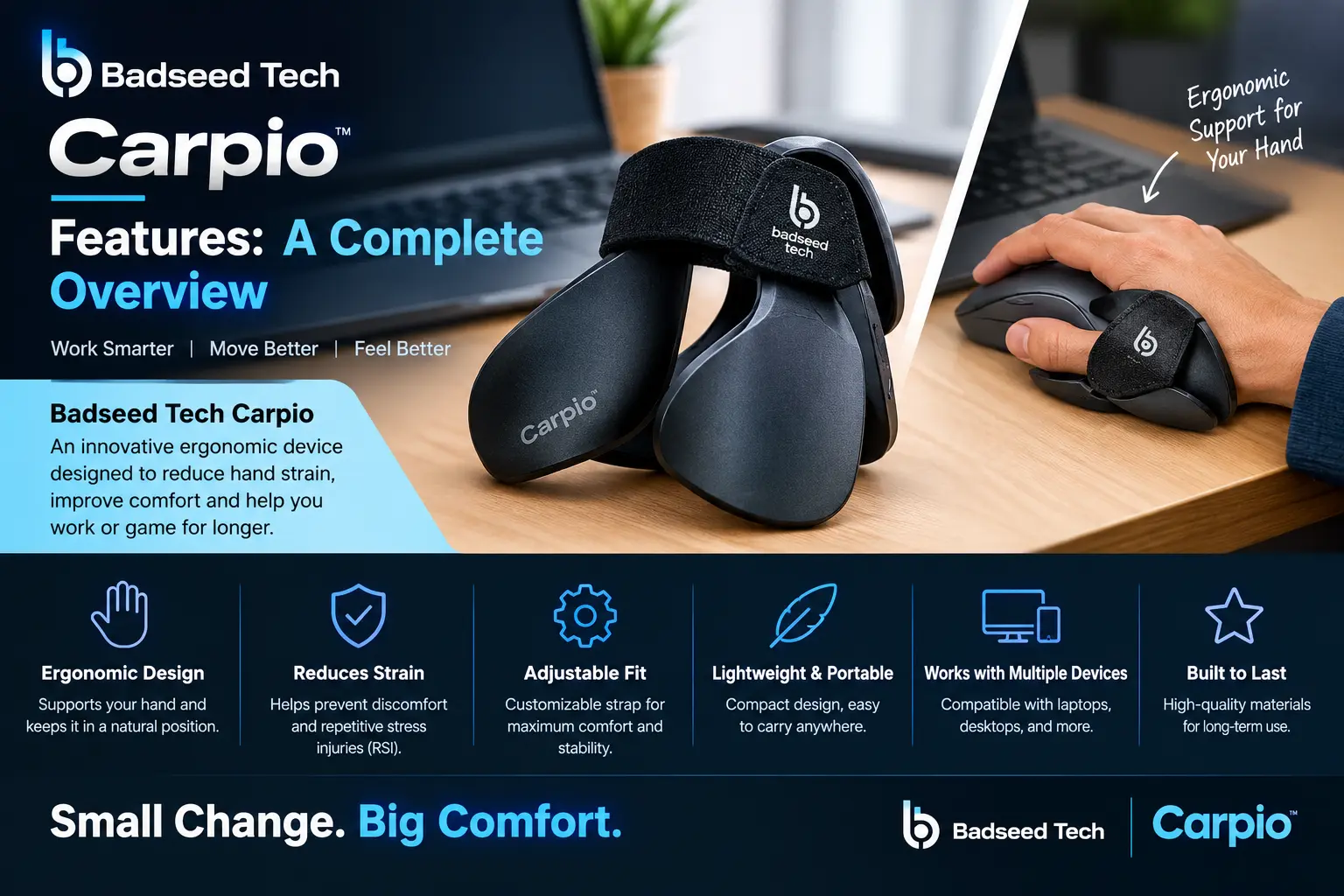
The Badseed Tech Carpio is an ergonomic palm and wrist support designed to sit beneath the hand during mouse or trackpad use, reducing the pressure and friction that build up over hours of repetitive movement. Rather than functioning as a static cushion, the Carpio is built to move with the hand — gliding smoothly across the desk surface instead of forcing the wrist to stay fixed in one position.
This distinguishes it from traditional wrist rests, which are typically stationary foam or gel pads that the wrist presses into and stays anchored to. That stationary design can actually contribute to strain over time, since it encourages the wrist to bend at an angle while the rest of the hand and forearm stay still. The Carpio’s moving, contoured design is meant to solve that specific problem by letting the whole hand glide naturally, keeping the wrist in a more neutral position throughout the day.
At its core, the Carpio is aimed at anyone who spends extended periods on a computer — office workers, gamers, designers, developers, and anyone managing early symptoms of wrist strain or repetitive stress discomfort.
2. Design Philosophy: Why Ergonomic Palm Support Matters
Repetitive strain injuries (RSI) and carpal tunnel-related discomfort are among the most common desk-related health complaints, and they’re largely driven by two things: sustained pressure on the wrist and unnatural hand positioning over long periods. Most standard mousepads and desks offer no real accommodation for this — the hand simply rests on a hard or flat surface for hours at a time.
The Badseed Tech Carpio’s design philosophy starts from a different premise: instead of asking the wrist to stay still and absorb pressure, let the whole palm and hand move together as a unit, supported and cushioned at every point of contact. This is the thinking behind its contoured shape, its low-friction underside, and its silicone contact pads — each feature works toward the same goal of reducing localized pressure and unnecessary strain.
It’s a similar concept to how ergonomic keyboards or vertical mice work: rather than forcing the body to adapt to a flat, one-size-fits-all tool, the tool is shaped to better match how the hand naturally moves.
The Problem With Static Wrist Rests
To understand why the Carpio’s moving design matters, it helps to look at what typically goes wrong with conventional wrist rests. A flat foam or gel pad sits in one fixed spot on the desk. The wrist rests on top of it, but as the hand moves the mouse left, right, forward, and back across the desk, the wrist has to pivot to accommodate that movement while staying anchored to the same point on the pad. Over the course of hundreds of small movements per hour, that repeated pivoting is exactly the kind of motion associated with wrist strain.
There’s also a pressure problem. Static rests are usually contacted at one narrow band along the underside of the wrist — right where the carpal tunnel sits, and right where nerve compression tends to originate. A support that’s meant to relieve strain can, in some cases, end up concentrating pressure in the worst possible place.
How a Moving Support Changes That Equation
By shifting the point of support from the wrist itself to the broader palm, and by allowing that support to glide across the desk instead of staying fixed, the Carpio changes both of the mechanics described above. The wrist doesn’t need to pivot as much because the whole hand — palm included — is moving together. And because contact is spread across the palm rather than concentrated on the wrist, there’s less pressure on the area most associated with discomfort in the first place.
This is a fairly different engineering approach than most accessories in this space take, and it’s the throughline connecting all of the Carpio’s individual features — from its contoured shape to its low-friction underside — back to a single design goal: reduce both the pressure and the repetitive bending that cause wrist fatigue in the first place.
3. Core Features and Functionality
Ergonomic Palm Support
The foundation of the Carpio is its contoured palm support. Instead of a flat surface, the support is shaped to follow the natural curve of the palm and the base of the wrist, spreading contact pressure across a wider area rather than concentrating it on one point — typically the underside of the wrist, which is where most discomfort originates during long mouse sessions. By supporting the fleshier part of the palm instead of the wrist itself, the Carpio helps keep the wrist closer to a neutral, unbent position, which is the posture most ergonomic guidelines recommend for reducing strain.
Smooth PTFE Gliding Feet
On the underside of the Carpio sit PTFE (polytetrafluoroethylene) gliding feet — the same ultra-low-friction material used on high-end mouse skates. These feet let the entire support slide smoothly across the desk or mousepad in sync with hand movement, rather than sticking or dragging. This is arguably the feature that most sets the Carpio apart from conventional wrist rests: instead of the hand moving around a fixed rest, the rest moves with the hand, which keeps the wrist angle consistent no matter where the cursor goes.
Custom Bad Seed Tech Colorway
The Carpio ships in a colorway designed and branded specifically by Badseed Tech, giving it a distinct look on the desk compared to generic, unbranded wrist supports. The colorway is part of what gives the product its identity within Badseed Tech’s broader lineup, and it’s designed to complement the rest of the product rather than being purely decorative — the finish is chosen to look good while also being practical for everyday handling.
Modular Design
The Carpio isn’t built as a single fused unit — it uses a modular construction where individual components, including the base, the palm rest, and the glide feet, can be separated and, where applicable, replaced or swapped. This matters for two reasons: longevity and personalization. If one component wears out (glide feet, for instance, naturally experience the most friction over time), it can potentially be replaced without needing to buy an entirely new unit. It also opens the door to mixing and matching components — like pairing a different pad color with the same base — for users who want to personalize their setup.
Size and Hand Options
Hands come in different sizes, and a support that’s shaped for an average hand won’t necessarily be comfortable for someone with notably larger or smaller hands, or for left-handed users working with right-hand-oriented peripherals. The Carpio addresses this by offering multiple sizing and hand-orientation options, so users can choose a fit that actually matches their hand rather than adapting their grip to fit the product.
Custom-Colored Silicone Pads
The points of direct skin contact on the Carpio are silicone pads, available in a range of custom colors. Silicone is a deliberate material choice here — it offers a soft, slightly grippy feel that stays comfortably in place against the skin without being tacky or restrictive, and it holds up well to repeated daily contact compared to foam, which tends to compress and lose shape over time. The ability to choose pad colors also ties back into the product’s personalization angle, letting users coordinate the Carpio with the rest of their desk setup.
4. Materials and Build Quality
The Carpio combines a few different materials, each chosen for a specific purpose rather than for looks alone:
- The base and structural body provide the rigid foundation that holds the modular components together and gives the unit enough structure to stay stable during use.
- PTFE glide feet handle the low-friction contact with the desk surface, prioritizing smoothness and durability over cushioning.
- Silicone contact pads handle the soft, skin-facing side of the product, prioritizing comfort and grip over rigidity.
This combination — a firm structural base paired with a soft, replaceable contact surface — is a common approach in ergonomic product design, since it lets each material do the job it’s best suited for instead of asking one material to handle both structure and comfort.
It’s worth noting why PTFE specifically was chosen for the glide feet rather than a more common material like rubber or standard plastic. PTFE has one of the lowest coefficients of friction of any solid material, which is exactly why it’s the standard choice for high-performance mouse skates and glide pads. Rubber or plastic feet would grip the desk surface rather than sliding across it, working against the entire point of a moving support. PTFE also resists wear reasonably well under repeated sliding contact, which matters for a component that’s in near-constant motion during use.
5. Sizing, Fit, and Customization
Because the Carpio is meant to sit directly under the palm during use, getting the size right matters more than it might for a purely decorative accessory. A support that’s too small won’t fully cushion the palm, while one that’s too large can interfere with natural hand movement or crowd the mouse itself.
The available size and hand-orientation options are meant to solve this by letting users pick a fit based on their own hand size and dominant hand, rather than using a single generic shape designed around an “average” hand that doesn’t reflect most users’ actual proportions.
On top of sizing, the combination of the custom colorway, modular components, and silicone pad color options means two Carpio units can look meaningfully different from each other while offering the same core ergonomic function — appealing to users who want their setup to reflect their own style as much as their comfort needs.
6. Comfort and Everyday Performance
In day-to-day use, the value of the Carpio comes down to how it changes the physical experience of using a mouse for hours at a time. The contoured palm support reduces the amount of pressure concentrated on any single point of the wrist, the PTFE feet let the hand move naturally instead of pivoting around a fixed rest, and the silicone pads keep the contact surface comfortable rather than sticky or slick.
Together, these features are designed to reduce the kind of cumulative strain that builds up gradually over a workday — the kind that’s easy to ignore in the moment but adds up over weeks and months of repeated use. For users who already deal with some wrist discomfort, the more neutral wrist position the Carpio encourages can make a noticeable difference; for users without existing discomfort, it functions more as a preventative measure.
The Adjustment Period
Because the Carpio moves rather than staying fixed, most new users go through a brief adjustment period — typically described as a matter of days rather than weeks — as the hand gets used to gliding with the support instead of pivoting around it. This is a natural consequence of the design and isn’t unique to the Carpio; any ergonomic tool that changes an ingrained movement pattern (a vertical mouse, a split keyboard, a standing desk) comes with a short learning curve before the new pattern starts to feel automatic. Once that adjustment happens, most of the motion becomes unconscious, the same way typing on a new keyboard layout eventually stops requiring active thought.
Temperature and Texture Feel
Because the contact surface is silicone rather than foam, it behaves differently to the touch throughout the day. Foam tends to absorb body heat and can feel warm or slightly damp after extended contact, while silicone stays cooler and doesn’t retain moisture in the same way, which many users find more comfortable during long sessions, particularly in warmer climates or well-used home offices without strong air conditioning.
7. Badseed Tech Carpio Specifications
| Specification | Details |
|---|---|
| Product type | Ergonomic palm and wrist support |
| Core feature | Contoured ergonomic palm support |
| Underside | PTFE low-friction gliding feet |
| Contact surface | Custom-colored silicone pads |
| Construction | Modular — components can be separated/replaced |
| Colorway | Custom Badseed Tech branded colorway |
| Sizing | Multiple sizes and hand-orientation (left/right) options |
| Compatible use cases | Desk mouse use, trackpad use, extended computer sessions |
| Customization | Interchangeable silicone pad colors, modular parts |
For exact dimensions, weight, and current pricing, check the official Badseed Tech product page, as these details can change between production runs.
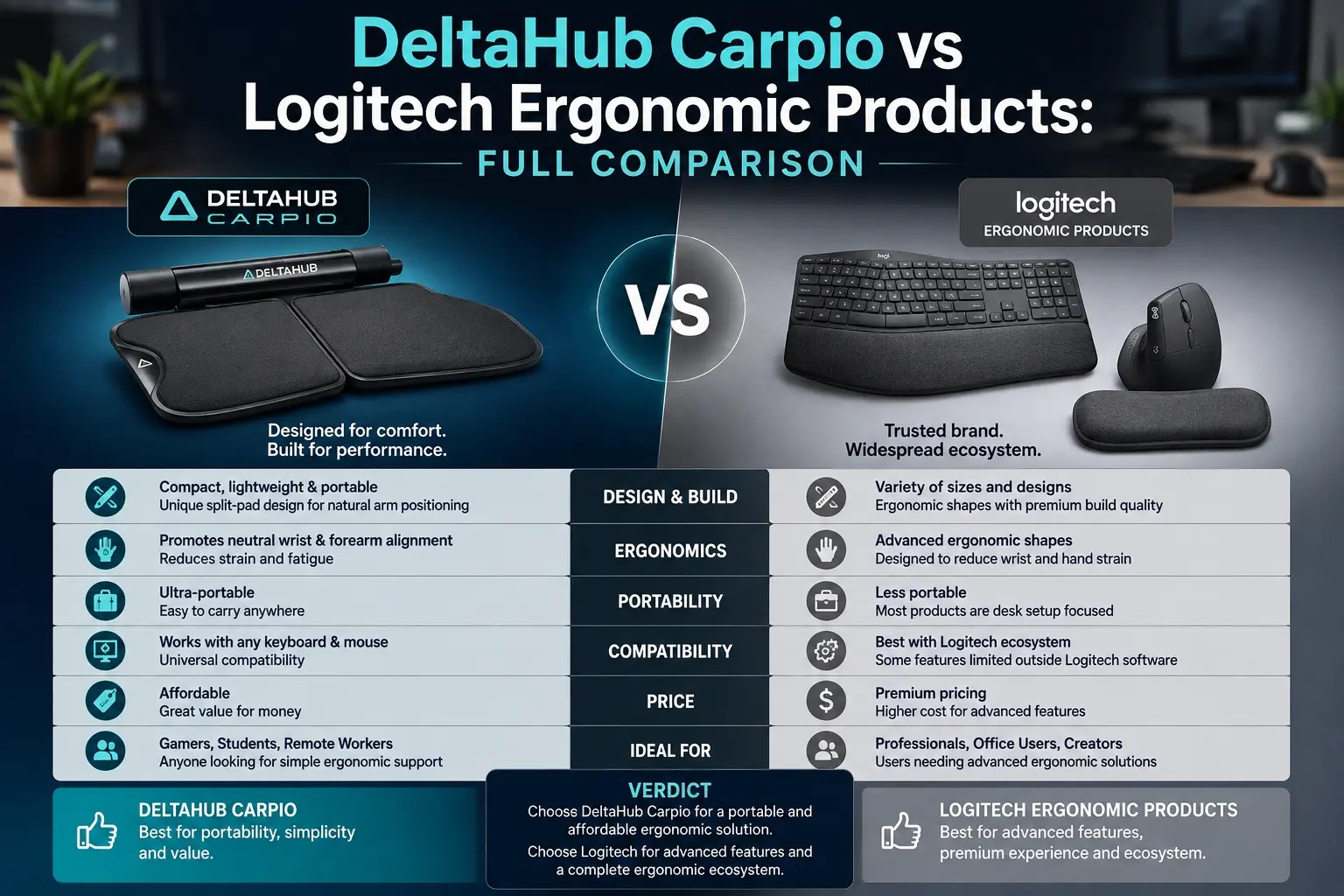
8. Badseed Tech Carpio vs. Traditional Wrist Rests
Most wrist rests on the market fall into one of two categories: flat foam pads or gel-filled cushions. Both are stationary — the wrist rests on top and stays largely in one place while the hand and fingers do the moving.
The Carpio takes a different approach by moving with the hand instead of staying fixed. This has a few practical implications:
- Wrist angle stays more consistent: With a stationary rest, the wrist has to bend as the cursor moves across the screen. With the Carpio’s gliding design, the whole hand shifts together, keeping the wrist angle closer to neutral.
- Less localized pressure: Foam and gel rests concentrate contact on the underside of the wrist itself. The Carpio’s palm-support shape spreads contact across the fleshier part of the hand.
- More personalization: Traditional wrist rests are typically one-size, one-color. The Carpio’s modular design and color customization give users more control over fit and appearance.
- Different maintenance considerations: Foam rests can compress and flatten over time, losing their cushioning. The Carpio’s modular, silicone-and-PTFE construction is designed with replaceable components in mind, which can extend its usable life.
The trade-off is that a moving support requires a bit of an adjustment period compared to a static one, since your hand needs to get used to gliding rather than staying anchored in place.
9. Pros and Cons
Pros
- Contoured ergonomic palm support spreads pressure more evenly than flat wrist rests
- PTFE gliding feet let the hand move naturally instead of pivoting around a fixed point
- Modular design allows individual components to be replaced rather than the whole unit
- Multiple size and hand-orientation options accommodate different hand shapes
- Custom-colored silicone pads and branded colorway allow for personalization
- Soft, skin-friendly silicone contact surface that resists compressing flat over time
Cons
- Moving-support design requires a short adjustment period for users used to stationary rests
- Sizing needs to be chosen carefully to get the intended ergonomic benefit
- As a specialized accessory, it’s a more considered purchase than a generic foam wrist pad
10. Who Should Buy the Badseed Tech Carpio?
Best for: Anyone who spends several hours a day using a mouse — office workers, gamers, designers, developers, and other desk-based professionals — especially those who notice wrist fatigue or discomfort by the end of the day.
Also good for: Users setting up an ergonomic workstation from scratch who want a wrist/palm solution that moves with natural hand motion rather than staying fixed in place.
Worth considering carefully for: Users with very specific existing wrist conditions, who should consult ergonomic or medical guidance alongside any product choice, since individual needs can vary significantly.
11. Real-World Use Cases
Long Work Sessions
For anyone working at a computer for a full 8-hour day, the cumulative effect of even small pressure points on the wrist can add up. The Carpio’s design is aimed squarely at this scenario — reducing the steady, low-level strain that builds up over a standard workday rather than addressing a single acute issue.
Gaming Setups
Gamers who spend extended sessions with precise, repetitive mouse movements can benefit from the Carpio’s gliding design, since it supports the hand through fast, frequent motion rather than anchoring it in place, which can otherwise interrupt quick movements.
Creative and Design Work
Designers and creative professionals who work extensively with a mouse or stylus for detailed, fine-motor tasks may find the consistent palm support helpful for maintaining comfort during long, detail-focused sessions.
Setting Up an Ergonomic Workstation
For anyone building out a more ergonomic desk setup — alongside things like an adjustable chair, monitor arm, or split keyboard — the Carpio fits in as the wrist/palm component of that broader setup.
Recovering From Wrist Fatigue or Early RSI Symptoms
For people who’ve started noticing mild wrist soreness, tingling, or stiffness after long computer sessions — often early warning signs rather than a diagnosed condition — an ergonomic support like the Carpio can be part of a broader response that also includes taking regular breaks, stretching, and adjusting desk and chair height. It’s not a medical treatment, but reducing the mechanical stress that contributes to those symptoms in the first place is a reasonable first step, alongside speaking with a healthcare provider if symptoms persist or worsen.
Shared or Multi-User Workstations
In shared desks or hot-desking environments where multiple people use the same setup throughout the day, the Carpio’s size options and modular, swappable components make it easier to keep a support on hand that can be adjusted or exchanged between users with different hand sizes, rather than everyone using an identical one-size pad regardless of fit.
12. Setup, Care, and Maintenance
Setting up the Carpio is straightforward: it’s placed on the desk in front of the mouse, positioned so the palm naturally rests on it during use. Because of its modular design, individual components can be removed for cleaning or replacement as needed, rather than requiring the entire unit to be cleaned or discarded as one piece.
The silicone contact pads, being a non-porous material, are generally easier to wipe down and keep clean compared to foam-based alternatives, which can absorb moisture and are harder to fully clean over time.
13. Frequently Asked Questions
What is the Badseed Tech Carpio used for? The Carpio is an ergonomic palm and wrist support designed to sit under the hand during mouse use, reducing pressure on the wrist and encouraging a more natural hand position during extended computer sessions.
How is the Carpio different from a regular wrist rest? Traditional wrist rests are stationary — the wrist stays in place while resting on the pad. The Carpio is designed to glide with the hand using low-friction PTFE feet, so the whole hand moves together rather than bending at a fixed point.
Does the Carpio come in different sizes? Yes. The Carpio is available in multiple sizes and hand-orientation options to accommodate different hand sizes and left- or right-handed use.
Can parts of the Carpio be replaced? Yes. The Carpio uses a modular design, meaning components such as the glide feet or silicone pads can potentially be replaced individually rather than requiring a full replacement.
Is the Carpio only available in one color? No. It ships in a custom Badseed Tech colorway, and the silicone contact pads are available in multiple custom colors, allowing for some personalization.
Who is the Badseed Tech Carpio best for? Anyone who spends significant time using a mouse throughout the day — including office workers, gamers, and creative professionals — particularly those looking to reduce wrist strain or set up a more ergonomic workstation.
14. Final Verdict
The Badseed Tech Carpio takes a genuinely different approach to wrist and palm support than the flat foam or gel pads most people are used to. Instead of asking the wrist to stay still and absorb pressure, it’s built to move with the hand — a design choice reflected in nearly every one of its core features, from the contoured palm support and PTFE gliding feet to the silicone contact pads that keep the surface comfortable during motion.
Its modular construction and customization options (colorway, pad colors, sizing, hand orientation) add a layer of flexibility and personalization that’s uncommon in this product category, where most options are one-size, one-color, and non-replaceable.
For anyone who spends long stretches of the day using a mouse — and especially for anyone already noticing wrist fatigue — the Carpio’s design philosophy addresses the actual mechanics of the problem rather than just cushioning the symptom. It’s a considered accessory rather than an impulse purchase, and getting the sizing right is worth taking seriously to get the full ergonomic benefit. For desk setups built around comfort and long-term wrist health, it’s a strong addition to consider.