

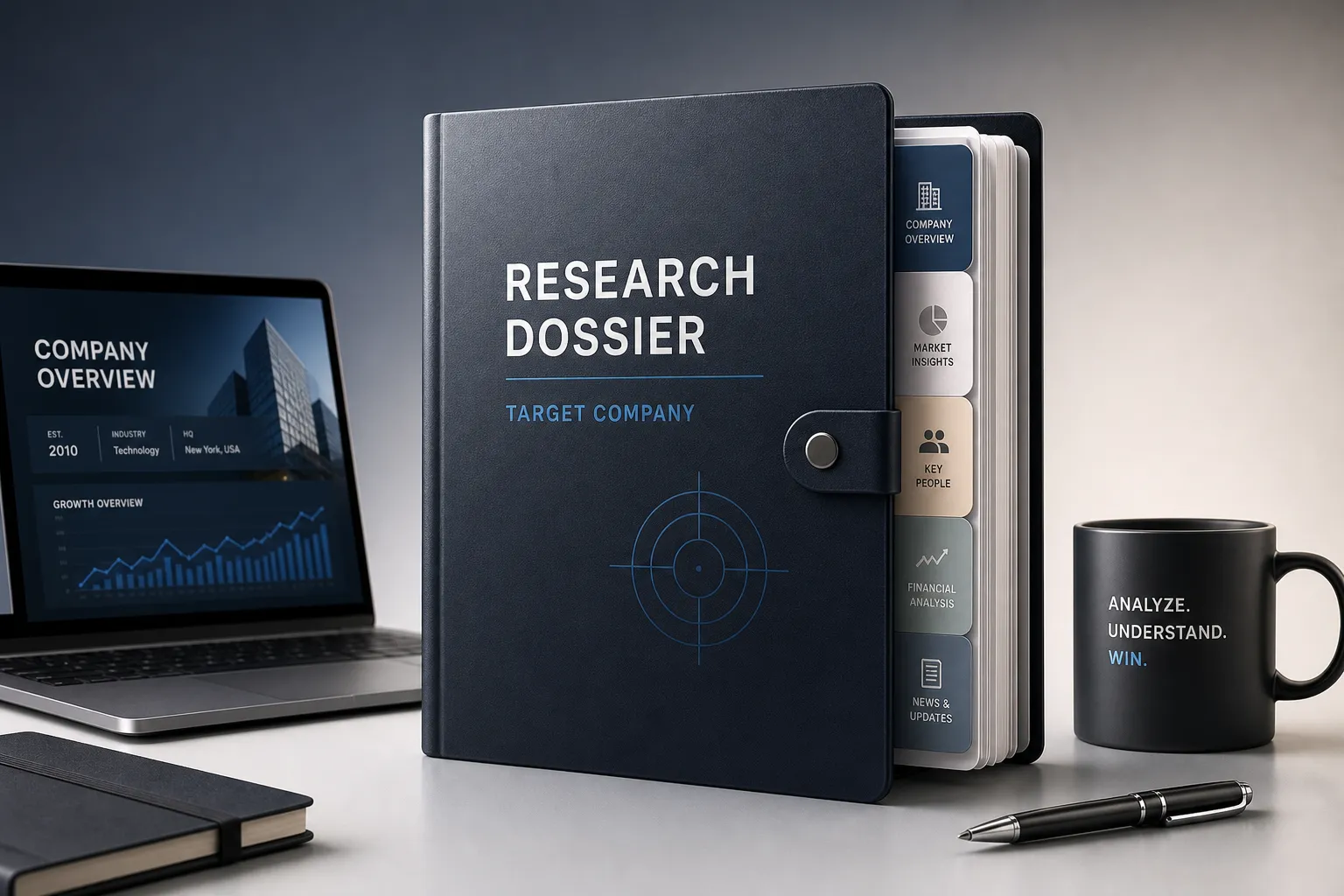
A research dossier for target company is a structured intelligence file that consolidates company identity, financials, leadership, digital presence, competitive position, and risk signals into a single decision-ready document. This guide gives you a practical section-by-section framework, a source checklist for both public and private companies, and a safe workflow for using AI to accelerate drafting without compromising accuracy. The seven-category structure covered below works for pre-meeting sales profiles and full acquisition due diligence alike; the difference is depth, not format.
This approach applies across a wide range of scenarios. Whether you are a sales professional evaluating prospects, a startup founder vetting potential partners, a marketing director scoping vendor choices, or an acquisition team running preliminary due diligence, the underlying structure is the same: a document that separates confirmed facts from estimates, records gaps honestly, and translates raw research into a clear recommendation.
Key takeaways
- Seven core categories: Every target-company dossier covers company identity, products and business model, financial position, leadership, technology and IP, legal, regulatory, and reputation profile, and competitive positioning.
- Executive summary goes last, reads first: Write it after completing the full document; keep it to three to five key findings and one recommended next action.
- Primary sources first: State registries, SEC EDGAR, and official filings outrank aggregator databases and commercial tools for entity and ownership verification.
- Two-source rule for financials: Always cross-reference financial figures; label private-company revenue as “estimated” with a clear source date.
- AI is a drafting accelerator, not a fact machine: Supply your own source documents, require claim IDs on every assertion, and manually verify every cited fact before the dossier is final.
- Document what you don’t know: A dossier that openly lists critical unknowns alongside confirmed facts is more actionable than one that papers over gaps, decision-makers need to know the boundary of what you actually verified.
What should a research dossier for a target company include?
The core categories that every dossier needs
A complete target-company dossier organizes findings into seven decision-relevant categories: company identity and corporate structure; products, services, and business model; financial position and funding signals; leadership and key decision-makers; technology stack and intellectual property; legal, regulatory, and reputation profile; and competitive positioning. Each category answers a specific question the decision-maker needs resolved, and each belongs in even the most streamlined dossier.
The depth required for each category depends on your purpose. A pre-meeting profile for a sales call focuses on identity, leadership contacts, recent developments, and likely pain points. A full acquisition due diligence dossier goes deeper on financials, ownership structure, IP, legal exposure, and workforce data. Regardless of purpose, every section should end with a confidence rating and a note on what data is still missing. Labeling unknowns is not a weakness; it protects the decision-maker from acting on incomplete information.
Template: research dossier for a target company (section-by-section)
Use the structure below as a repeatable starting point. For each section, record the source, the date retrieved, and a confidence rating (confirmed, estimated, or unverified). A section left intentionally blank with a note on why it is missing is more useful than a section filled with unsourced inference.
- Company identity: Legal name, incorporation state and date, registered agent, DBA names, and current status from the relevant Secretary of State database.
- Products, services, and business model: Core offerings, revenue model, customer segments, and pricing structure where publicly available.
- Financial position: Revenue range, funding history, and valuation, labeled as estimated for private companies, with source dates.
- Leadership and decision-makers: Named executives, board members, recent changes, and LinkedIn-verifiable tenure.
- Technology stack and IP: Stack detected via technology-detection tools, patents filed or held, and any open-source contributions.
- Legal, regulatory, and reputation profile: Litigation history, regulatory filings, and third-party reputation signals from public review sources.
- Competitive positioning: Market segment, named competitors, differentiation claims, and press coverage sentiment.
The executive summary: why it comes last but reads first
Write the executive summary after completing the rest of the document, then place it first. It should contain three to five key findings, the primary opportunity, the primary risk, the most critical unknown, and a recommended next action, all fitting on a single page. The decision-maker reading your dossier should be able to act on the summary alone if time is short.
The supporting sections exist to justify the findings, not to be read front to back. A stakeholder who needs to dig into financial details or legal exposure can do so; the summary gives them the signal before they spend time on the detail. That structure is what separates a decision-ready intelligence file from a long document that sits unread.
Where do you actually find reliable company information?
Public sources for ownership, structure, and corporate history
Start with free, authoritative sources before reaching for paid tools. For U.S. entities, state Secretaries of State databases are the primary source for legal existence, formation date, registered agent, officers, and current status. SEC EDGAR is the authoritative source for public-company filings, including 10-K and 10-Q reports, proxy statements, beneficial-ownership disclosures, and subsidiary lists. For international targets, UK Companies House covers British entities, OpenCorporates enables cross-border entity discovery across roughly 140 jurisdictions, and the EU Business Registers framework covers European companies.
State registries confirm legal existence and registered officers; EDGAR adds ownership, subsidiaries, and governance detail for public companies. Beneficial-owner data for private U.S. entities is often thin in public records. Most states do not require shareholder or LLC-member information in formation filings, so private-company ownership typically requires additional corroborating sources to confirm.
Where to find financial data on private companies
For public companies, SEC EDGAR is always the first stop, followed by investor-relations pages and standardized databases like Compustat or FactSet. Private companies require a different approach because they don’t file comprehensive financial statements publicly. The table below shows where to look by data type.
| Data need | Recommended source | Note |
|---|---|---|
| Public company financials | SEC EDGAR, company IR page | Primary source; verify against original filings |
| Private company revenue estimate | PitchBook, PrivCo, S&P Capital IQ, D&B | Label as “estimated” with source date |
| Funding and valuation | PitchBook, Crunchbase, PrivCo | Cross-reference at least two sources |
| Long historical financial series | Compustat, Capital IQ, Mergent, FactSet | Best for standardized comparisons |
| Quick free screening | Yahoo Finance, company website | Verify key figures against original filings |
Apply the two-source rule consistently: cross-reference every figure and label private-company revenue as “estimated” with a clear source date. Court filings, franchise disclosure documents, and bond offering memoranda can surface audited figures that commercial databases don’t carry, so those sources are worth checking when database estimates seem inconsistent.
How do you evaluate a company’s digital presence and tech stack?
Reading a company’s digital footprint as evidence
A company’s website, service pages, and published work are primary evidence of capability and operational maturity. Technology-detection tools can surface the stack a target company runs without requiring any access to internal systems. LinkedIn headcount and job-posting patterns reveal growth direction: a company aggressively hiring frontend engineers can signal a product expansion worth noting in the competitive section. Search visibility, reputable review platforms, and social content cadence indicate market activity and brand investment.
Treat inconsistencies between claimed services and visible output as a risk signal worth documenting. An agency that claims ten service lines but shows minimal public evidence of delivery warrants scrutiny. Document those gaps in the dossier’s risk section with a clear note on what verification would close them, a direct conversation, a reference check, or a third-party review source are all valid next steps.
What a transparent vendor looks like in a target-company dossier
When building a company background investigation for a digital agency prospect, a well-structured vendor makes the researcher’s job considerably faster. The evidence a researcher needs is already public and traceable: clearly scoped service descriptions, verifiable technology choices, and communication practices that match stated capabilities. BadSeed Tech Carpio offers Shopify-based e-commerce, Flutter mobile app development, and AWS cloud hosting.
That level of specificity shortens the dossier process considerably. When a target company is opaque, generic descriptions, no verifiable output, note it as a risk signal. Opacity may reflect a confidentiality policy, or it may indicate a company that cannot back its claims; either way, it belongs in the open questions section until resolved through direct verification.
How should you organize your findings for a real decision?
Turning raw findings into a risk-and-opportunity framework
Raw notes do not constitute a dossier. Organize findings into a risk-and-opportunity matrix with columns for issue type, likelihood, potential impact, supporting evidence, and a suggested next step or mitigation. Financial risks belong in their own block, separate from legal, reputational, and technology risks. Opportunities, a recent funding round, a leadership upgrade, a platform migration, should be documented in the same table format so they can be weighed against risks in the executive summary.
This structure keeps the dossier actionable. A stakeholder who reads the matrix understands not just what was found but what it means and what to do next. The difference between a document that drives a decision and one that gets filed and forgotten comes down to whether the findings are organized to answer a question or just to record information.
Tracking gaps and open questions before any decision
Every research dossier for target company needs a dedicated section for what you could not confirm. For each open question, record why it matters, what evidence currently exists, how to verify it, and who owns the next step. Management confirmation, third-party records, and follow-up source requests are all valid verification paths, and each should be assigned to a named owner with a deadline so nothing stays open indefinitely.
Rate the overall evidence confidence for the dossier as a whole, not just for individual claims. For example, a dossier that openly labels its critical unknowns alongside its confirmed findings gives a decision-maker a clearer picture of actual risk than one that presents everything at the same confidence level. Decision-makers need to know the boundary of what you actually know.
Can AI help you compile a dossier faster without sacrificing accuracy?
A prompt pattern that works for dossier drafts
AI can accelerate dossier drafts significantly, but the workflow matters as much as the tool. Use the Goal-Context-Sources-Expectations-Constraints framework when prompting a language model. Supply the source documents yourself rather than letting the model draw from its training data. Instruct it to assign a claim ID and source location to every factual assertion, and require it to flag missing evidence as “not established” rather than filling gaps with inference.
For large dossiers, stage the work: inventory sources first, extract and normalize claims second, draft by section third, then critique the draft for unsupported statements. Asking the model to produce a claim-evidence matrix before prose generally makes omissions and unsupported assertions easier to detect and correct before they reach the final document.
The verification steps you cannot skip after AI output
AI drafts require a mandatory verification pass before any claim enters a final due diligence report. Open every cited source and confirm it exists and actually supports the wording used. Check that quotations are exact and in context. Flag currency issues, since AI training data has a cutoff date that can make recent developments invisible to the model. Corroborate high-stakes claims with at least one independent source, and test language strength against the actual evidence.
“The company reported” is not the same as “the company did.” Run a final claim-status pass with columns for claim, source, corroboration, risk level, and reviewer sign-off. No claim enters the final document as an established fact until it has passed a manual check by a human reviewer who has read the original source, not just the AI’s summary of it.
Frequently asked questions about building a research dossier
What is a research dossier for a target company?
A research dossier for a target company is a structured intelligence document that consolidates verified facts about an organization, covering identity, financials, leadership, technology, legal standing, and competitive position, into a format that supports a specific decision, such as a partnership, acquisition, or vendor selection.
How long should a target-company dossier be?
Length depends on purpose. A pre-meeting sales profile may run three to five pages; a full acquisition due diligence dossier can run significantly longer. In both cases, the executive summary should fit on a single page, and every additional section should earn its place by answering a question the decision-maker actually needs resolved.
How do you verify private-company financials in a dossier?
Private companies do not file public financial statements, so verification requires layering multiple sources: commercial databases such as PitchBook, PrivCo, or S&P Capital IQ for revenue estimates; court filings, franchise disclosure documents, and bond memoranda for audited figures when available; and direct inquiry or reference calls when database estimates conflict. Always label private-company figures as “estimated” and note the source and retrieval date.
Is AI reliable for building a company research dossier?
AI is a useful drafting tool when used with discipline: supply your own source documents, require claim IDs on every assertion, and run a manual verification pass on every fact before it enters the final document. AI training data has a cutoff date, which means recent developments may be missing or outdated. Use it to accelerate structure and synthesis, not as a substitute for primary-source verification.
Putting it all together
A research dossier for target company is a living document that reflects the current state of your knowledge, with clearly labeled gaps and a recommended next action placed where a decision-maker can find it immediately. Its value is not in volume but in honesty: what you confirmed, what you estimated, and what remains open.
Start with the seven-category framework, pull from primary public sources before commercial databases, evaluate digital presence as evidence rather than background noise, and use AI as a drafting accelerator with a disciplined verification layer on top. A well-built company profile research checklist makes the difference between a decision grounded in evidence and one built on assumption. BadSeed Tech Carpio serves clients across the United States and internationally. If you are evaluating digital agency partners for a web, mobile, or e-commerce project, reach out to the BadSeed Tech Carpio team with your questions.
