

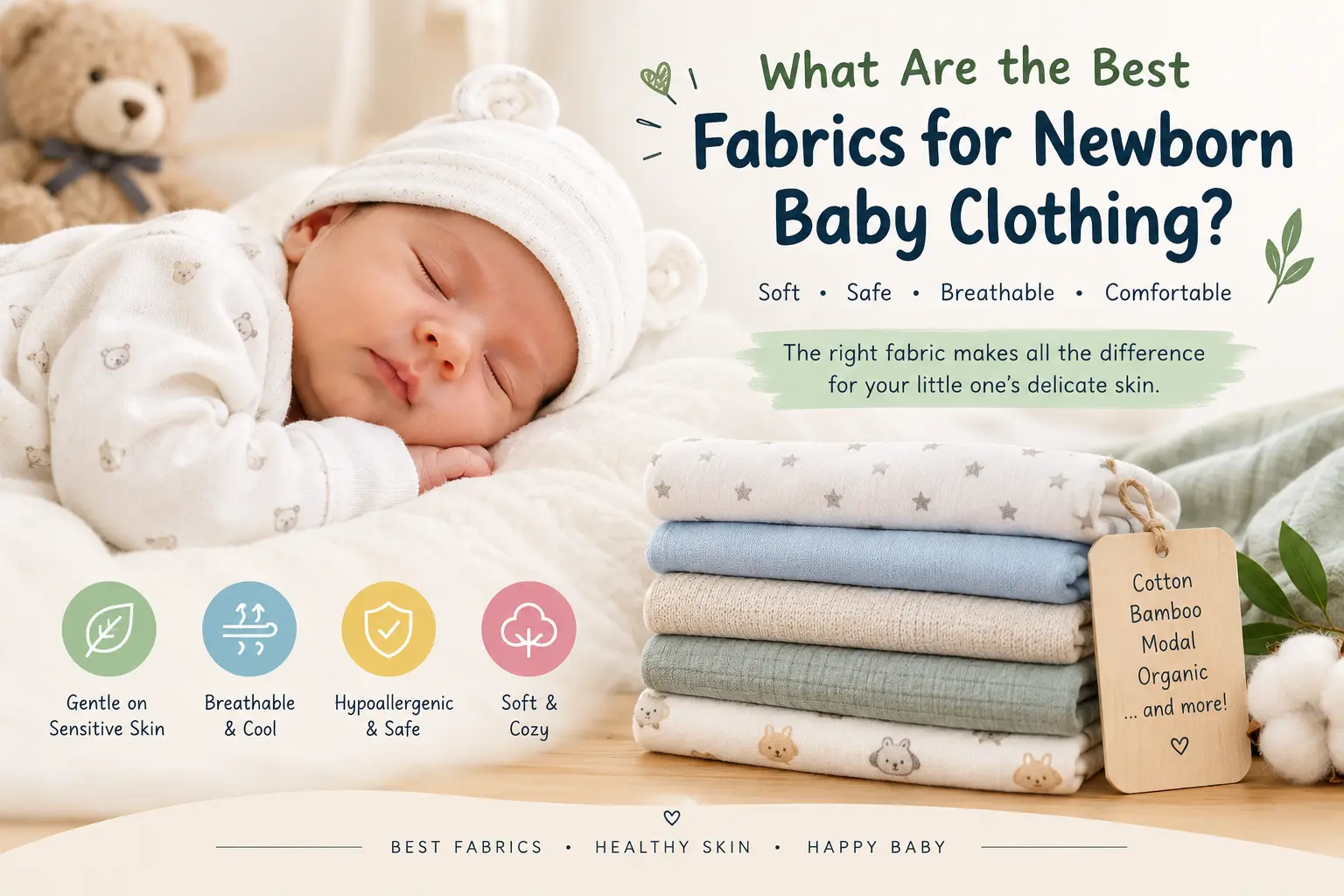
Choosing clothes for a newborn is one of the most exciting parts of preparing for a baby. Parents often spend time selecting attractive colours, adorable prints, comfortable designs and matching outfits. However, one important factor deserves even more attention: the fabric.
A newborn spends much of the day sleeping, feeding, being carried and resting in a parent’s arms. Clothing stays close to the baby’s delicate skin for many hours, so the material should feel comfortable, allow appropriate airflow and be easy to wash. Parents should also consider the weather, the baby’s individual skin needs and how the garment fits.
What are the best fabrics for newborn baby clothing? In most situations, soft cotton, organic cotton and lightweight cotton muslin are excellent starting choices. They are widely available, comfortable for everyday use and suitable for many climates. Other options, including bamboo-derived viscose, linen, merino wool and cotton blends, may also work well when parents choose carefully.
There is no single fabric that is perfect for every newborn, every season and every situation. A lightweight cotton bodysuit may be ideal on a warm day, while a warmer cotton garment or suitable wool layer may be more comfortable during cold weather. The goal is to choose clothes that keep the baby comfortable without causing overheating, irritation or unnecessary discomfort.
Quick Answer: What Is the Best Fabric for Newborn Baby Clothes?
For most families, soft, lightweight cotton is an excellent everyday choice for newborn clothing. Organic cotton is another option for parents who prefer organically produced fibres and can verify the relevant certification. Cotton muslin is especially useful for lightweight clothing and other products designed for warm conditions.
Here is a quick overview of common materials.
| Fabric | Best use | Main consideration |
|---|---|---|
| Soft cotton | Everyday bodysuits, vests and sleepsuits | Choose a comfortable weave and suitable thickness |
| Organic cotton | Everyday clothing for parents who prefer certified organic textiles | Check the certification and garment quality |
| Cotton muslin | Lightweight summer outfits and suitable wraps | Very thin muslin is not suitable for every purpose |
| Pima cotton | Soft, durable everyday garments | Often costs more than standard cotton |
| Bamboo-derived viscose | Soft, draping clothing | Check the fibre description, care instructions and product quality |
| Linen | Lightweight warm-weather outfits | Some linen feels rough until softened through use and washing |
| Merino wool | Appropriate cool-weather layers | Avoid overheating and check for individual sensitivity |
| Cotton blends | Stretchy or easy-care garments | Check the fibre composition and how the fabric feels |
These are practical guidelines rather than a medical ranking. No fabric is guaranteed to prevent every rash or allergic reaction. A garment’s construction, dyes, seams, fit, cleanliness and the baby’s individual needs matter too.
1. Why Fabric Choice Matters for Newborn Baby Clothing
Newborn clothing needs to do more than look attractive. It should support comfort during daily activities, allow parents to change nappies easily and withstand frequent washing.
Newborn skin needs gentle care
A newborn’s skin is still developing. It may be more easily irritated by friction, moisture, rough seams or certain substances than an older child’s skin.
A scratchy label, stiff seam or rough fabric can cause discomfort, especially around the neck, wrists, ankles and areas where clothing rubs repeatedly. Soft materials and well-finished garments can reduce avoidable friction.
Parents should remember that a fabric labelled “natural” is not automatically suitable for every baby. Natural fibres can still cause individual reactions, and a synthetic fabric is not automatically unsafe simply because it is synthetic.
The best approach is to inspect the finished garment rather than judging it by the fibre name alone.
Temperature control is important
Babies need adults to help them stay at a comfortable temperature. Clothing that traps too much heat may make a newborn uncomfortable, while insufficient clothing in cold conditions may leave the baby too chilly.
Breathable, appropriately lightweight clothing is helpful in warm weather. In cooler conditions, several suitable light layers can be easier to adjust than one very heavy garment.
The NHS recommends lightweight cotton clothing in hot weather and advises parents to avoid overheating their babies. See the NHS guide to dressing a newborn.
Babies need frequent clothing changes
Newborns can spit up milk, leak through nappies and produce small messes during feeding. Parents therefore need clothing that can be washed regularly without becoming rough, misshapen or difficult to use.
Cotton is popular because it is widely available and generally straightforward to care for. However, the care label matters. Some delicate fabrics need gentler washing or lower drying temperatures.
Comfort matters during sleep and rest
Babies spend many hours sleeping, but fabric choice alone does not make a sleep environment safe. Clothing must suit the room temperature, and parents should avoid excessive layers.
For sleep, follow current safe-sleep advice. Keep the baby’s head uncovered indoors and avoid loose bedding, pillows and other soft objects in the sleep space. A suitable, correctly sized wearable blanket may be an option when appropriate for the baby’s age, room temperature and product instructions.
2. Cotton: An Excellent Everyday Fabric for Newborns
Cotton is one of the most practical materials for newborn baby clothing. It is widely available, comes in different thicknesses and works for many everyday garments.
Soft cotton is a sensible starting point for parents who want comfortable clothing without paying premium prices for every item.
Benefits of cotton baby clothes
Comfortable against the skin: A well-made cotton garment can feel soft and smooth, particularly when the fabric and seams are properly finished.
Breathability: Many cotton fabrics allow air to circulate, although performance depends on the weave, thickness and construction.
Moisture absorption: Cotton absorbs moisture, which can be helpful during warm weather. However, damp clothing should be changed promptly because moisture trapped against the skin can contribute to discomfort.
Easy care: Many cotton baby garments can be machine-washed according to their care labels.
Wide availability: Parents can find cotton bodysuits, vests, sleepsuits, leggings, hats and other baby essentials in a range of prices.
Which cotton fabric is best for newborn clothes?
Cotton comes in several forms. The differences matter when choosing garments.
- Cotton jersey: A soft knitted fabric commonly used for bodysuits, T-shirts and everyday clothing.
- Cotton interlock: A double-knit structure that can feel thicker and smoother than lightweight single jersey.
- Brushed cotton: Cotton finished to create a softer, warmer surface, often suitable for cooler conditions.
- Cotton rib knit: A stretchy fabric that can fit comfortably around the body when properly designed.
- Lightweight woven cotton: Useful for shirts, loose outfits and some warm-weather garments.
The best choice depends on the garment. Lightweight jersey may work well for everyday warm-weather clothing, while a slightly thicker cotton knit may be useful in cooler conditions.
Potential disadvantages of cotton
Cotton is not perfect. It can shrink if washed or dried incorrectly, and some garments wrinkle more than others. Thick cotton may feel too warm in hot weather, while thin cotton may provide insufficient insulation in cold conditions.
Cotton can also remain damp after absorbing moisture. Parents should change wet garments and allow clothing to dry fully before using it again.
When should parents choose cotton?
Cotton is a good option for:
- Everyday bodysuits and vests.
- Daytime outfits.
- Lightweight sleepsuits suitable for the room temperature.
- Clothing worn directly against the skin.
- Easy-care garments that need frequent washing.
When shopping for the best fabric for baby clothes, start with soft cotton garments and then select the appropriate thickness for the season.
3. Organic Cotton: Is It Better for Newborns?
Organic cotton is a popular choice among parents who want to understand how the fibres used in their baby’s clothing were produced.
The term generally refers to cotton grown under a recognised organic production standard. Exact requirements depend on the certification scheme.
Organic cotton can be an excellent material for newborn clothing, but parents should understand what the term does and does not guarantee.
Benefits of organic cotton baby clothes
Organic cotton can offer the same practical advantages as conventional cotton, including comfort, breathability and everyday usability.
Parents may also prefer it because certified organic production restricts certain agricultural inputs and follows defined production requirements.
If environmental production methods are important to your family, a recognised certification can provide more meaningful information than a general marketing statement.
Is organic cotton safer than regular cotton?
Not necessarily in every finished garment.
Organic production does not automatically mean that a garment contains no chemicals, dyes or finishing agents. The finished textile still needs to be manufactured, coloured, sewn and treated.
Likewise, properly manufactured conventional cotton clothing can be comfortable and suitable for newborns.
For babies with sensitive skin, consider the complete garment, including its dyes, finishes, seams and labels. Wash new clothing before use and observe whether the baby develops any irritation.
How to identify certified organic cotton
When shopping, look for specific information about the product and its certification.
Useful things to check include:
- The stated fibre composition.
- The name of the certification scheme.
- Whether the certification applies to the fibre, processing stages or finished product.
- The manufacturer’s product details.
- Clear washing and care instructions.
For example, a textile certification may address different matters from an organic agricultural certification. Parents should not assume that every label verifies the same properties.
Is organic cotton worth the extra cost?
That depends on your budget and priorities.
If organic production matters to you and the product provides credible certification information, paying more may be worthwhile. However, parents do not need to buy an entirely organic wardrobe to choose comfortable clothing for a newborn.
A small selection of well-made, washable cotton garments can be a practical starting point.
4. Cotton Muslin: A Useful Choice for Warm Weather
Muslin is a lightweight fabric traditionally made from cotton. Its open construction can allow substantial airflow, making it useful for certain warm-weather garments and baby products.
In India and other warm climates, cotton muslin is often called malmal. The precise texture and thickness vary between products.
Benefits of muslin fabric for newborns
Lightweight feel: Muslin can feel less heavy than thicker cotton fabrics.
Air circulation: An open weave can help air move through the material.
Quick drying: Lightweight muslin often dries relatively quickly after washing, depending on the fabric and conditions.
Versatility: It is used in some baby outfits, burp cloths, wraps and other textile products.
Softening with washing: Many cotton muslin products become softer with regular washing, provided the care instructions are followed.
Is muslin better than regular cotton?
Neither is universally better.
Muslin is a type of fabric construction, while cotton describes the fibre. Both materials can be made from cotton, so the comparison is often between lightweight, loosely woven cotton muslin and a different cotton fabric.
For hot weather, lightweight muslin may offer more airflow than a thick cotton knit. For everyday bodysuits, however, a soft cotton jersey may provide better coverage, stretch and durability.
Choose the construction that suits the garment rather than assuming that one name always means better quality.
Can newborns wear muslin clothes every day?
Yes, when the garment is designed for everyday wear and provides suitable coverage, fit and durability.
However, very thin muslin may not be the best choice for every outfit. Parents should inspect the fabric for loose threads, rough seams and excessive transparency.
A muslin swaddle or wrap should also be used according to safe-sleep guidance. Avoid loose fabric around a sleeping baby’s face, and stop swaddling when the baby shows signs of attempting to roll.
Is muslin suitable for winter?
Lightweight muslin alone may not provide enough warmth in cold weather. It can still be useful as a light layer when combined with suitable clothing.
The important factor is the baby’s overall clothing and the temperature of the environment, not the fabric name alone.
For parents looking for the best summer fabrics for newborns, lightweight cotton muslin is a practical option worth considering.
5. Pima Cotton: A Premium Option
Pima cotton is a variety of cotton known for its relatively long fibres. Longer cotton fibres can be spun into smooth yarns, which may produce soft and durable fabrics.
Some premium newborn clothing brands use Pima cotton for bodysuits, sleepsuits and other everyday garments.
Advantages of Pima cotton
- It can feel smooth and comfortable against the skin.
- Good-quality fabric may resist pilling better than some lower-quality alternatives.
- It can provide a refined finish for everyday clothing.
- It is available in different knitted and woven constructions.
The final quality still depends on the yarn, fabric construction, finishing and garment manufacturing.
Disadvantages of Pima cotton
Pima cotton products often cost more than standard cotton garments. That premium does not automatically make them more suitable for a newborn.
A reasonably priced cotton bodysuit with smooth seams may be just as practical for everyday use.
Parents should also check the care label because premium cotton can still shrink, fade or lose shape if handled incorrectly.
Who should choose Pima cotton?
Pima cotton may appeal to parents who want a particularly smooth fabric and are comfortable paying more for it. It is an optional upgrade rather than a newborn essential.
For most families, softness, appropriate thickness, a comfortable fit and easy washing are more important than buying the most expensive cotton variety.
6. Bamboo Fabric for Baby Clothes
Bamboo-derived fabrics are frequently marketed for their silky texture and softness. Some parents prefer them because the material drapes smoothly and feels different from ordinary cotton.
However, the term “bamboo fabric” can be misleading if the actual fibre is not clearly identified.
Many garments sold as bamboo clothing are made from bamboo-derived viscose or rayon. This is a regenerated cellulose fibre produced through processing rather than simply bamboo stems woven directly into fabric.
Benefits of bamboo-derived viscose
Depending on the construction, bamboo-derived viscose may offer:
- A smooth, soft feel.
- Flexible draping.
- A lightweight texture.
- Comfortable everyday wear when appropriately designed.
- A pleasant feel for parents who dislike rough or stiff fabrics.
These characteristics vary between products.
What should parents know about processing?
The manufacturing process matters. Bamboo-derived viscose is made by processing cellulose into a usable textile fibre, and some production methods involve chemical solvents.
Parents who care about environmental impact or textile processing should investigate the manufacturer’s information and any credible third-party certifications.
A product should not be described as completely chemical-free simply because its raw material came from bamboo.
Is bamboo viscose better than cotton for newborns?
There is no universal winner.
Bamboo-derived viscose may feel softer or more fluid to some people, while cotton may be more familiar, widely available and straightforward to compare across products.
The right choice depends on the finished garment, how it performs after washing, the climate and the baby’s individual comfort.
How to shop for bamboo baby clothes
Before buying, check:
- Whether the product is labelled viscose, rayon or another specific fibre.
- Whether the manufacturer provides clear material information.
- Whether the garment can be washed as often as newborn clothing usually requires.
- Whether seams and labels are comfortable.
- Whether credible certifications support any special safety or environmental claims.
Parents do not need to avoid all bamboo-derived fabrics. They should simply make decisions based on clear product information rather than marketing claims.
7. Linen: A Lightweight Option for Hot Climates
Linen is made from flax fibres. It is known for its characteristic texture and can be useful for lightweight warm-weather clothing.
Linen is more common in some baby shirts, dresses, loose outfits and occasion wear than in basic newborn bodysuits.
Benefits of linen baby clothing
Linen fabrics can allow airflow, particularly when they are lightweight and loosely woven. They are also known for their natural texture and distinctive appearance.
For parents living in hot climates, a loose linen outfit may be a comfortable option for supervised daytime use.
Potential disadvantages
Some linen feels firmer or rougher than soft cotton jersey, especially when new. It also wrinkles easily, and some garments require more careful washing or ironing.
A stiff garment with rough seams may not be ideal for a newborn, even if the fibre itself is breathable.
Linen is therefore not automatically the best fabric for every baby outfit.
How to choose linen for a newborn
Look for a soft, lightweight garment with smooth seams and a comfortable fit. Avoid stiff decorations, scratchy labels and tight waistbands.
Linen may be useful for occasional outfits or loose summer clothing, while cotton remains a more versatile choice for many daily essentials.
8. Merino Wool: A Useful Option for Cooler Weather
Wool is a natural fibre obtained from sheep. Merino wool comes from Merino sheep and is often valued for its relatively fine fibres.
Some merino wool garments feel softer than traditional coarse wool. Appropriate merino clothing can be useful for layering in cooler conditions.
Benefits of merino wool
Depending on the garment, merino wool can provide warmth without requiring a particularly bulky layer. Wool also interacts with moisture differently from cotton and may be useful in selected outdoor or cool-weather clothing.
Lightweight merino garments can be used as a layer over or under other clothing when appropriate for the weather.
Is wool suitable for every newborn?
No. Some babies may find wool irritating, especially when the fibres are coarse or the garment rubs against the skin.
Parents should also consider the baby’s skin condition and any history of reactions to particular textiles. If a material appears to trigger irritation, stop using it and seek medical advice when appropriate.
How to use merino wool safely
Choose a garment with a soft finish, comfortable seams and a suitable fit. Follow the washing instructions because some wool garments can shrink or become damaged when washed incorrectly.
Do not use a thick wool layer simply because the weather is cold. Check the baby’s temperature and adjust clothing to prevent overheating.
Merino wool can be a useful option for suitable cool-weather layers, but it is not a replacement for appropriate safe-sleep clothing and bedding practices.
9. Are Synthetic Fabrics Suitable for Newborn Clothing?
Synthetic fibres include polyester, nylon and acrylic. These materials are used in many clothing products because they can be durable, inexpensive, stretchy or quick-drying.
It is too simplistic to say that every synthetic fabric is dangerous for babies. Suitability depends on the fibre, fabric construction, garment design, finishing and the individual baby’s needs.
However, some synthetic fabrics may feel less breathable or trap more warmth than lightweight cotton, depending on how they are made.
Polyester baby clothes
Polyester is commonly used in fleece jackets, outerwear and blended fabrics. It can be practical for some purposes, but thick polyester clothing may be too warm for a hot environment.
If you choose polyester, inspect the fabric, follow the care instructions and consider how much warmth the garment provides.
Nylon clothing
Nylon appears in some outerwear, accessories and blended textiles. It is generally less common as the primary fabric in basic newborn bodysuits.
The main consideration is whether the finished garment is comfortable, appropriate for the weather and free from design features that could create hazards.
Acrylic baby clothes
Acrylic is sometimes used as an alternative to wool in knitwear. Some acrylic garments can feel soft, while others may feel less comfortable or trap heat.
Check the garment’s texture and warmth rather than relying solely on its name.
Should parents avoid all synthetic fabrics?
Not necessarily. A suitable synthetic outer layer may have a useful role, particularly in cool weather.
For clothing that touches the skin throughout the day, many parents prefer soft cotton because it is familiar, widely available and comfortable in a range of lightweight constructions.
The key is to avoid choosing clothing solely because it is fashionable, inexpensive or advertised as a special fabric. Consider the complete product and the environment in which the baby will wear it.
10. Cotton vs Muslin vs Bamboo: Which Is Best?
Parents often compare cotton, muslin and bamboo-derived fabric because these materials are widely marketed for baby clothing.
The first important distinction is that cotton is a fibre, muslin is a fabric construction, and bamboo viscose is a regenerated cellulose textile fibre. These are not exactly equivalent categories.
Here is a practical comparison.
| Feature | Cotton jersey | Cotton muslin | Bamboo-derived viscose |
|---|---|---|---|
| Typical feel | Soft and familiar | Lightweight and airy | Often smooth and fluid |
| Common use | Bodysuits and sleepsuits | Light outfits and wraps | Bodysuits and soft garments |
| Warm-weather suitability | Good when lightweight | Often very useful | Depends on weight and construction |
| Stretch | Depends on knit structure | Usually limited | Depends on construction |
| Durability | Often good with proper care | Varies with weave and thickness | Varies by product |
| Care | Often straightforward | Often straightforward | May need more careful washing |
| Main consideration | Select suitable thickness | Thin fabric may offer limited coverage | Check fibre details and processing |
Which fabric is best for hot weather?
Lightweight cotton jersey and cotton muslin are both practical choices. Muslin can offer substantial airflow because of its open weave, while jersey may provide better coverage and stretch.
A lightweight bamboo-derived viscose garment may also be comfortable, depending on its construction.
Which fabric is best for everyday use?
Soft cotton is an excellent starting point because it is widely available and generally easy to care for. Parents who prefer a more open weave may choose muslin garments for suitable purposes.
Which fabric is best for sensitive skin?
There is no single fabric that works for every baby with sensitive skin. Soft cotton is often a reasonable first choice, but parents should also inspect seams, dyes, labels and garment fit.
If a baby develops persistent irritation, ask a healthcare professional for advice instead of repeatedly changing fabrics without identifying the cause.
11. How to Choose Newborn Clothes for Indian Weather
Climate should influence fabric selection. A clothing combination that works during a cool winter in northern India may be uncomfortable during a hot and humid summer in Mumbai or Chennai.
Parents should consider indoor temperatures as well as outdoor weather. Air conditioning, ceiling fans, humidity and time spent outside can all affect clothing choices.
Summer: Choose lightweight fabrics
During hot weather, consider:
- Lightweight cotton bodysuits.
- Soft cotton vests.
- Cotton muslin garments designed for clothing.
- Loose-fitting cotton outfits for supervised daytime use.
Avoid unnecessary layers. Check the baby’s chest or back for signs of excessive warmth rather than relying only on the temperature of the hands and feet.
The NHS recommends lightweight cotton clothing during hot weather. MedlinePlus also advises keeping babies cool and dry and using lightweight, soft cotton clothing to help avoid heat rash.
References: NHS newborn clothing advice and MedlinePlus information on heat rash.
Monsoon: Consider drying time
During monsoon weather, humidity can make laundry take longer to dry.
Lightweight cotton and suitable muslin garments may be practical because they often dry more quickly than thick clothing. However, drying time depends on the weave, garment thickness, ventilation and humidity.
Make sure clothing is fully dry before storing it or dressing the baby. Damp garments can feel uncomfortable and may develop unpleasant odours.
Keep enough clean outfits available so that you do not have to reuse clothing that is still damp.
Winter: Use adjustable layers
Winter clothing should keep the baby comfortably warm without creating excessive insulation.
Soft cotton garments can work as a base layer, with additional clothing selected according to the room temperature and outdoor conditions. Suitable wool or other warm layers may be useful when needed.
Avoid automatically dressing the baby in several heavy layers just because it is winter. Indoor rooms may be warm, especially when heaters are used.
Air-conditioned rooms
A baby may need a light additional layer in a cool room, but the right choice depends on the actual temperature.
A comfortable cotton bodysuit with an appropriate additional layer may be sufficient in many situations. Check the baby’s chest or back and adjust clothing when needed.
Do not use a hat indoors simply to keep a baby warm unless a healthcare professional has advised otherwise for a specific reason.
Outdoor clothing
When going outside, consider the weather, duration of the outing and whether the baby will be exposed to direct sunlight or cold wind.
Use clothing and sun protection appropriate to the conditions. Young babies should be kept out of direct sunlight, and a pram should not be covered with a blanket or muslin in a way that traps heat.
12. What Fabric Is Best for Babies With Sensitive Skin?
Parents often search for hypoallergenic baby clothing because they want to minimise irritation.
However, no textile can guarantee that a baby will never develop a rash or allergic reaction. The cause may be friction, heat, moisture, detergent residue, a skin condition or a reaction to a particular ingredient or material.
Start with simple garments
Consider choosing:
- Soft, lightweight cotton clothing.
- Smooth seams and flat labels.
- Comfortable neck openings.
- Clothing without rough embroidery against the skin.
- Garments with minimal irritating decorations.
- Materials that tolerate regular washing.
Avoid tight clothing that rubs repeatedly against the skin.
Pay attention to seams and labels
A garment may be made from excellent cotton but still irritate the baby if the inside seams are rough.
Inspect the neck, armholes, cuffs and leg openings. Remove or safely cover irritating labels when possible, without creating loose threads or other hazards.
Watch for heat and moisture
Sweat and damp clothing may contribute to irritation, particularly in skin folds.
Change wet or soiled garments promptly. Keep skin folds clean and dry, and avoid using unnecessary fragranced products on a newborn’s skin.
When should parents seek medical advice?
If a rash persists, spreads, becomes painful, blisters or appears infected, contact a healthcare professional. Seek urgent medical advice if a newborn has a fever or seems unwell.
Do not assume that every rash is caused by fabric. A clinician can help determine whether the issue relates to irritation, eczema, infection or another cause.
13. What to Look for When Buying Safe Fabrics for Newborns
Fabric selection is only one part of buying safe baby clothes. The complete garment should be designed and manufactured appropriately for newborn use.
Check the fibre composition
Read the label to understand what the garment contains. A product advertised as cotton may include polyester or elastane.
Blends are not automatically unsuitable, but parents should know what they are buying and consider the garment’s intended purpose.
Look for credible textile certifications
Some textile certifications assess specific aspects of production, processing or chemical safety.
For example, OEKO-TEX STANDARD 100 is a textile testing certification that can provide information about testing for certain harmful substances. GOTS is an organic textile standard with defined requirements for certified products and production stages.
These certifications are not interchangeable, and parents should verify the actual product or supplier claim rather than assuming every item from a brand carries the same certification.
A certification can provide useful information, but it does not guarantee that a garment will never irritate a particular baby’s skin.
Inspect buttons, snaps and zippers
Closures should be securely attached and designed for the garment’s intended use.
Check for loose buttons, damaged snaps, sharp edges and exposed zipper parts. Follow the product’s instructions and stop using clothing with damaged or loose components.
Choose a comfortable fit
Newborn clothes should not be so tight that they restrict movement or rub the skin. They should also not be excessively loose if the design creates a risk of fabric covering the baby’s face or catching on objects.
Choose garments specifically designed for the baby’s size and stage of development.
Avoid unnecessary decorations
Large bows, loose cords, detachable ornaments and poorly attached decorations may create hazards.
For newborns, simple designs are often easier to wash, easier to put on and more practical for frequent clothing changes.
Check the washing instructions
Newborn clothes need regular washing. Choose garments that fit your household’s laundry routine and follow the manufacturer’s instructions.
If a product requires delicate care, consider whether you can maintain it properly before buying several items.
14. How to Wash Newborn Baby Clothes
Proper care helps clothing remain comfortable and usable. It also removes ordinary dirt and residue from garments before they touch the baby’s skin.
Wash new clothes before use
Wash newly purchased garments before dressing your baby in them. Follow the care label and make sure the items dry completely.
This is a practical precaution, but washing does not turn an unsuitable garment into a safe one. Parents should still check the fabric, construction and closures.
Use a suitable detergent
Choose a detergent that cleans effectively and can be rinsed out properly. If your baby has sensitive skin, you may prefer an unscented product with a simple formulation.
There is no need to assume that every standard detergent will cause irritation. If a rash repeatedly appears after laundry changes, discuss the pattern with a healthcare professional.
Follow temperature instructions
Different fabrics tolerate different washing temperatures. Cotton may tolerate a wider range of settings than delicate viscose or merino wool, but the garment label should guide your choice.
Do not use very hot water indiscriminately. Excessive heat may shrink or damage some clothing.
Avoid excessive fabric softener
Fabric softener is not necessary for every garment. If your baby seems sensitive to a particular laundry product, try simplifying the laundry routine and seek professional advice if the irritation continues.
Dry clothing completely
Allow garments to dry thoroughly before storing them. In humid climates, use adequate ventilation or an appropriate drying appliance when available.
Avoid storing damp clothes in closed cupboards or laundry baskets for extended periods.
Inspect clothing after washing
Check for:
- Loose threads.
- Broken snaps.
- Damaged zippers.
- Roughened seams.
- Shrinkage that affects fit.
- Fabric holes or thinning areas.
Repair or discard garments that are no longer safe or comfortable to use.
15. How Many Newborn Clothes Should Parents Buy?
New parents sometimes purchase too many outfits before the baby arrives. However, newborns grow quickly, and some babies outgrow the smallest sizes within a short period.
A practical wardrobe should provide enough clean clothing for regular changes without requiring excessive spending.
The NHS suggests a small collection of essentials, including approximately six stretch suits and six vests as a starting point. Actual needs depend on laundry frequency, climate, feeding patterns and the baby’s size.
A simple newborn clothing checklist
- Six to eight everyday bodysuits or vests.
- Four to six sleepsuits appropriate for the climate.
- Two or three additional outfits for daytime use.
- A few pairs of socks or booties when needed.
- Weather-appropriate hats for outdoor use.
- One or two suitable warm layers for cooler conditions.
- Enough burp cloths and other washable essentials.
These are flexible suggestions rather than strict requirements. Families who wash clothes daily may need fewer items, while families with less frequent laundry access may need more.
Focus on practical clothing
Prioritise easy-to-use garments with comfortable neck openings and accessible fasteners.
Wrap-style tops or clothes with convenient openings can make dressing easier during the first few weeks. Look for designs that allow nappy changes without unnecessary handling.
Avoid buying every size in advance
Start with a modest selection of newborn and slightly larger sizes. Once you know how quickly your baby grows and which designs work best, you can purchase additional clothing.
Choosing a smaller number of versatile, well-made garments is often more economical than buying many specialised outfits.
16. Common Mistakes to Avoid When Choosing Newborn Fabrics
Even well-intentioned parents can make clothing decisions based on assumptions rather than practical needs.
Mistake 1: Choosing fabric by softness alone
A fabric can feel wonderfully soft but still be too warm, difficult to wash or poorly suited to the intended garment.
Consider breathability, thickness, fit and care requirements as well as softness.
Mistake 2: Assuming organic always means safer
Organic production claims do not automatically guarantee that every aspect of a finished garment is suitable for every baby.
Check the certification, garment construction and product information.
Mistake 3: Believing expensive fabric is always better
A premium fabric may offer particular benefits, but a more expensive garment is not necessarily more comfortable or practical.
A well-made cotton bodysuit may meet your baby’s needs perfectly well.
Mistake 4: Dressing the baby according to outdoor temperature alone
Indoor temperatures can be very different from outdoor conditions.
Check the room and the baby’s body temperature, and remove or add layers as appropriate.
Mistake 5: Using too many layers
Overdressing can make babies too hot. Choose clothing that suits the actual environment rather than automatically adding several layers.
Mistake 6: Ignoring the garment’s construction
Rough seams, loose buttons, scratchy labels and poorly fitted closures can make otherwise good fabric uncomfortable or unsafe.
Inspect the finished garment before use.
Mistake 7: Reusing damp clothing
Damp clothes can feel uncomfortable and may contribute to skin irritation. Change wet garments promptly and allow washed items to dry fully.
Mistake 8: Trusting every marketing claim
Words such as “natural,” “chemical-free,” “hypoallergenic” and “eco-friendly” do not all have the same meaning.
Look for clear fibre descriptions, credible certifications and specific product information.
17. A Practical Buying Guide: How to Choose the Best Fabric
When shopping online or in a store, use a simple decision-making process.
Step 1: Identify the garment’s purpose
Ask yourself whether you need an everyday bodysuit, a warm sleepsuit, a summer outfit or a cool-weather layer.
A lightweight fabric may work well for one purpose but not another.
Step 2: Consider the climate
For hot weather, start with lightweight cotton or muslin. For cooler weather, consider suitable cotton layers or other appropriate materials that provide additional warmth.
Step 3: Inspect the finished garment
Check the seams, labels, closures, decorations and overall fit. The quality of construction can be just as important as the fibre.
Step 4: Read the composition label
Look for the actual fibre percentages rather than relying on the product title.
For example, a garment described as a cotton blend may contain a substantial proportion of another fibre.
Step 5: Review the washing requirements
Choose clothing that fits your laundry routine. Easy-care materials can save time when frequent changes are needed.
Step 6: Consider credible certification
If organic production or textile testing matters to you, verify the claim and understand what the certification covers.
Step 7: Buy a small number first
Try a few garments before buying a large collection. Check how they feel, fit and perform after washing.
Step 8: Observe your baby’s comfort
Watch for signs of excessive warmth, dampness, redness or discomfort. If a particular garment repeatedly causes irritation, stop using it while you investigate the cause.
This method is more reliable than choosing clothing solely by brand popularity, price or fabric trends.
18. Are Natural Fabrics Always Better Than Synthetic Fabrics?
Natural fibres such as cotton, linen and wool have useful characteristics, but natural origin alone does not guarantee comfort or safety.
The quality of the finished textile, the processing methods, the weave and the garment design all matter.
Some natural fabrics are rough or heavy. Some synthetic fabrics are designed for specific functions and may be suitable for selected garments.
Parents should compare products on their actual merits rather than assuming that one broad category is always superior.
What matters most?
For everyday newborn clothing, consider these priorities:
- Comfortable contact with the skin.
- Appropriate warmth for the environment.
- Suitable airflow and moisture management.
- A secure, comfortable fit.
- Safe garment construction.
- Straightforward washing and drying.
- Clear and credible product information.
Cotton often performs well against these practical criteria, which is why it remains a sensible first choice for many families.
19. The Best Fabrics for Different Newborn Clothing Items
Different garments have different requirements. Selecting fabric according to the intended use can help parents build a more practical wardrobe.
Bodysuits and vests
Soft cotton jersey is an excellent starting point. It is commonly available, comfortable and generally easy to wash.
Choose a design with smooth seams and convenient fasteners.
Sleepsuits
Cotton jersey or interlock may be suitable, depending on the season and room temperature.
Choose sleepwear appropriate for the baby’s size and the environment. Follow safe-sleep advice and avoid excessive clothing layers.
Summer outfits
Lightweight cotton and suitable muslin clothing can be useful when temperatures are high.
Choose loose, comfortable garments that provide appropriate coverage without unnecessary warmth.
Winter outfits
Cotton base layers can be combined with suitable warm clothing when needed. Lightweight wool garments may also be useful for some families.
Check the baby’s temperature regularly and adjust layers rather than relying on a fixed number of garments.
Hats and socks
Cotton may be a practical choice for many hats and socks. For cold-weather outdoor use, other materials may provide additional warmth.
Remove indoor hats when they are not needed, and avoid overheating.
Burp cloths
Cotton and cotton muslin are popular choices because they absorb moisture and can be washed regularly.
Choose products with adequate thickness for their intended use.
Swaddles and wraps
Cotton muslin is widely used for lightweight wraps, but safe swaddling requires attention to technique and the baby’s development.
Never allow loose fabric to cover the face. Stop swaddling when the baby shows signs of attempting to roll, and follow current safe-sleep recommendations.
A fabric that is suitable for clothing is not automatically suitable for every sleep product.
20. Sustainability and Environmentally Conscious Baby Clothing
Some parents want to choose newborn clothing that is comfortable while also considering environmental impact.
Buying more sustainably does not necessarily mean purchasing the most expensive organic collection. It can also involve buying fewer garments, choosing durable products and using them for longer when appropriate.
Buy fewer, more versatile garments
Newborns grow quickly, so a large collection of specialised outfits may go unused.
Choose everyday garments that can be mixed and matched and washed easily.
Prioritise durability
A garment that maintains its shape and remains comfortable after repeated washing may offer better long-term value than one that quickly becomes damaged.
Inspect seams, closures and fabric quality before buying.
Consider second-hand clothing
Clean, well-maintained second-hand garments can be a practical option. Check every item carefully for loose buttons, broken zippers, damaged elastic, rough areas and other hazards.
Follow the same care and safety checks that you would use for new clothing.
Understand organic and sustainability claims
Organic certification can provide useful information about production, but it does not automatically establish the environmental impact of every part of a garment’s lifecycle.
If sustainability is important to you, look for specific claims that explain the product’s materials, manufacturing practices and certification.
Avoid assuming that any single fibre is always the most environmentally responsible option.
21. Expert-Informed Safety Tips for Newborn Clothing
The fabric is important, but it should be considered alongside broader newborn care.
The following practical points reflect common public-health guidance.
Prevent overheating
Babies can become too hot when they wear excessive clothing or are exposed to excessive warmth.
Watch for sweating, flushed skin or a chest that feels hot. Remove unnecessary layers and adjust the environment when appropriate.
Keep the head uncovered indoors
Babies can lose and gain heat through their heads. Avoid unnecessary indoor hats and ensure that the baby’s head remains uncovered during sleep unless a healthcare professional has given specific instructions otherwise.
Use sleep products correctly
Loose blankets, pillows and other soft objects should not be placed in the baby’s sleep space. Choose suitable sleep clothing and follow recognised safe-sleep recommendations.
Keep clothing in good condition
Do not use garments with loose buttons, broken fasteners, sharp components or damaged parts that may create hazards.
Ask for help when problems persist
If a newborn has repeated rashes or discomfort that appears linked to clothing, discuss it with a healthcare professional.
Parents should not rely on fabric changes alone to diagnose or treat a skin condition.
For additional information, consult the NHS guidance on newborn essentials and the NIH Safe to Sleep programme.
22. Frequently Asked Questions About Newborn Baby Clothing Fabrics
What are the best fabrics for newborn baby clothing?
Soft cotton, organic cotton and lightweight cotton muslin are excellent starting choices for many newborn garments. The best option depends on the season, garment construction, washing needs and the baby’s individual skin sensitivity.
Is 100% cotton best for newborns?
Soft, well-made 100% cotton clothing is a practical option for many newborns. However, the percentage alone does not determine quality. Fabric thickness, seams, fit and finishing also matter.
Is organic cotton better than regular cotton for babies?
Organic cotton may appeal to parents who prefer certified organic production. Both organic and conventional cotton can be comfortable and suitable for newborn clothing. Check the finished garment and verify any certification claims.
Is muslin safe for newborns?
Muslin clothing can be suitable when the garment is designed for newborn use and provides appropriate coverage. Lightweight muslin is useful for some warm-weather products. Swaddles and wraps must be used according to safe-sleep guidance.
Which fabric is best for newborns in summer?
Lightweight cotton and cotton muslin are practical options for hot weather. Choose breathable garments, avoid unnecessary layers and keep the baby out of direct sunlight.
Which fabric is best for newborns in winter?
Soft cotton base layers can be combined with suitable additional layers when needed. Merino wool may be useful for some cool-weather garments. Choose clothing according to the room temperature and avoid excessive warmth.
Is bamboo fabric good for newborn clothes?
Bamboo-derived viscose can feel smooth and soft, but its performance depends on construction and processing. Check the fibre description, product quality and care label before buying.
Can polyester be used for newborn clothing?
Some polyester garments can be suitable for particular purposes, such as outerwear. Consider breathability, warmth and the baby’s comfort. Do not assume that every synthetic material is unsafe or that every natural material is suitable.
Which fabric is best for babies with sensitive skin?
Soft cotton is often a reasonable starting point, but no fabric guarantees freedom from irritation. Look for smooth seams, comfortable fits and simple designs. Seek medical advice if a rash persists or worsens.
Are hypoallergenic baby clothes completely allergy-proof?
No. “Hypoallergenic” does not guarantee that a baby will never react to a product. Babies can respond differently to fibres, dyes, finishes, detergents and other factors.
Should I wash newborn clothes before using them?
Yes, washing new baby clothes before use is a sensible precaution. Follow the care label, dry the garments completely and inspect them before dressing your baby.
Do newborns need expensive baby clothes?
No. Expensive fabric is not a requirement for comfortable newborn clothing. Well-made, washable cotton garments can be practical and affordable.
How many newborn outfits should I buy?
A small initial collection of everyday bodysuits, vests and sleepsuits is usually sufficient for many families. Adjust the quantity according to laundry access, climate and how frequently clothing needs changing.
Is linen suitable for newborns?
Soft, lightweight linen can work for certain warm-weather outfits. Check that the garment does not feel stiff or rough and that its fit is comfortable.
Is merino wool safe for newborns?
Appropriately designed merino wool garments may be useful for cool-weather layers. Check softness, fit and care instructions, and avoid overheating. Stop using a garment if it appears to cause irritation.
What fabric is best for newborn sleeping clothes?
Soft cotton sleepwear may be suitable, depending on the room temperature and garment design. Choose appropriate sleep clothing, avoid excessive layers and follow current safe-sleep guidance.
Does cotton prevent baby rashes?
No fabric can guarantee that a baby will not develop a rash. Cotton may be comfortable for many babies, but heat, moisture, friction and skin conditions can still cause irritation.
Is muslin better than cotton?
Muslin is often made from cotton, so the comparison is usually between different fabric constructions. Lightweight muslin may offer more airflow, while cotton jersey may provide better stretch and coverage for bodysuits.
Which newborn fabric dries quickly?
Lightweight cotton muslin often dries relatively quickly because it is thin. Actual drying time depends on thickness, humidity, airflow and the drying method.
How can I tell if a newborn is too hot in their clothes?
Check the baby’s chest or back for excessive warmth and look for sweating or flushed skin. Remove unnecessary layers and reassess the environment. Do not rely only on the temperature of the hands and feet.
Are certified fabrics necessary for newborn clothes?
Certifications can provide additional information about production or textile testing, but they are not the only way to evaluate clothing. Check the garment’s construction, material details, care instructions and the credibility of any product claims.
Conclusion: Choosing the Best Fabric for Newborn Baby Clothing
Choosing the best fabric for newborn baby clothing does not have to be complicated. Start with the practical needs of your baby, the climate where you live and how often the clothes will be washed.
Soft cotton is an excellent everyday starting point: Organic cotton is worth considering if certified organic production matters to your family, while lightweight muslin can be especially useful for suitable warm-weather garments. Pima cotton, bamboo-derived viscose, linen and merino wool each have potential benefits, but their suitability depends on the particular garment and how it will be used.
Before buying, check the fibre composition, fabric thickness, seams, closures and washing instructions. Choose comfortable clothing that suits the temperature, and avoid adding unnecessary layers. Wash new garments before use and pay attention to your baby’s comfort.
Remember that the most expensive fabric is not automatically the best, and no material can guarantee that a baby will never experience irritation. Practical design, appropriate clothing, safe-sleep habits and careful observation matter just as much as the fibre itself.
By focusing on softness, suitable breathability, easy care and safe construction, you can build a comfortable newborn wardrobe without spending more than necessary.
