

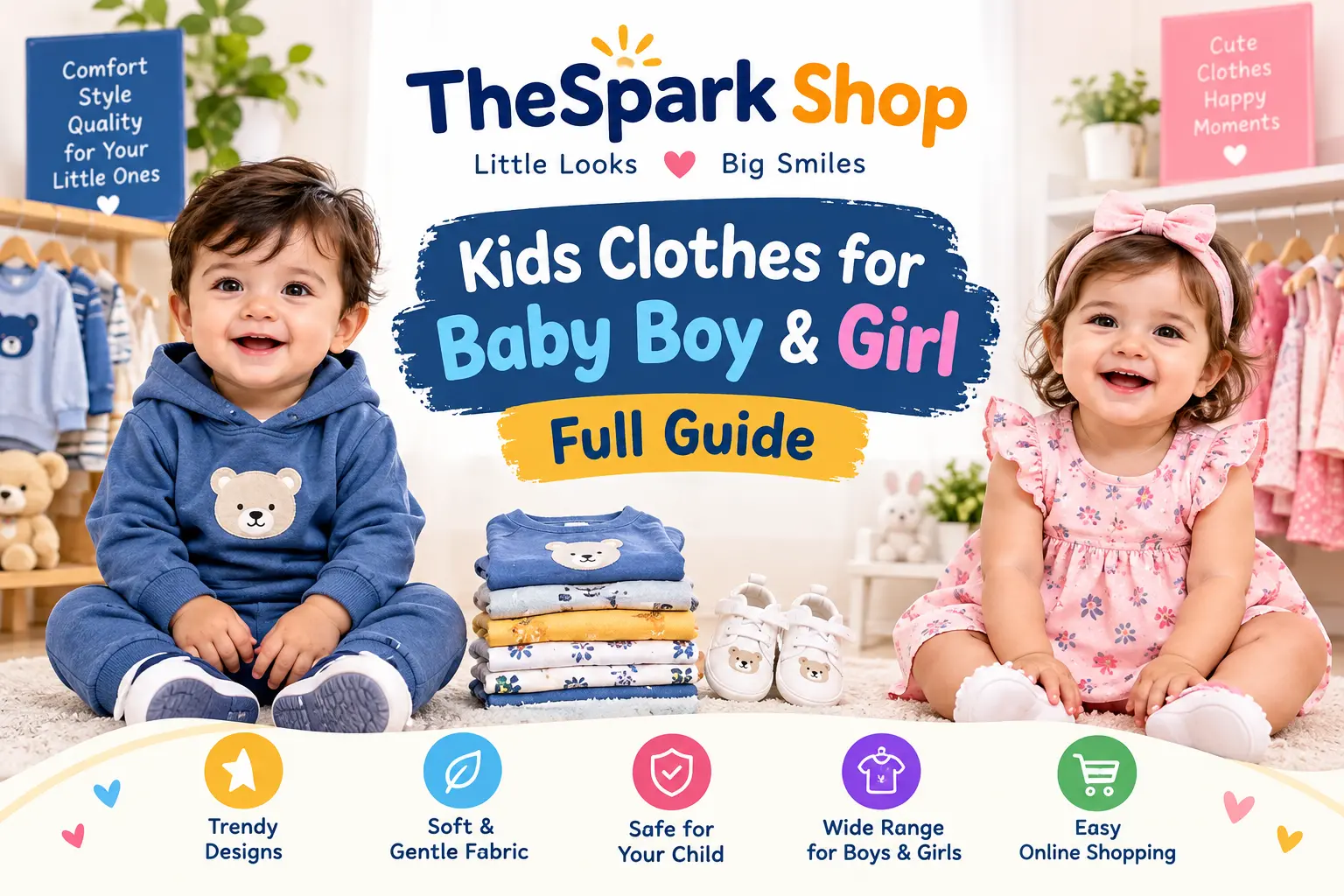
Dressing a baby sounds like the easiest job in the world until you actually try it. The sleeve is too tight, the neckline won’t go over the head, the fabric pills after two washes, and the size that fit last month now stops halfway down the tummy. This is exactly why thespark shop kids clothes for baby boy & girl has become such a heavily searched phrase among new parents — people want one reliable place to find soft, safe, affordable outfits without scrolling through forty tabs.
This guide is not a two-minute listicle. It walks through every practical thing you need to know before you buy thespark shop baby clothes or any other kidswear online: what the collections actually contain, which fabrics suit Indian weather, how to read a size chart properly, what safety features matter on infant garments, how to build a small wardrobe that lasts, and how to wash it all so it survives the year. By the end you should be able to shop with confidence instead of guessing.
What TheSpark Shop Kids Clothing Range Covers
TheSpark Shop is positioned as an online store for everyday kidswear, with a catalogue that spans newborn sizes through to primary-school ages. The listings that show up most often under thespark shop kids clothes for baby boy & girl fall into a handful of recognisable buckets:
- Bodysuits and onesies — the foundation layer for the first year, usually with shoulder envelope necks and crotch snaps.
- Rompers and jumpsuits — one-piece outfits that skip the waistband problem entirely.
- Co-ord sets — matching top and bottom sold together, which is the most common toddler format.
- Frocks and dresses — everyday cotton styles plus dressier options for functions.
- T-shirts, shorts and joggers — the separates that get used most between ages two and six.
- Sleepwear and night suits — full-length, soft-knit, usually loose-fitting.
- Seasonal layers — sweatshirts, hoodies, thermals, fleece jackets for winter; sleeveless and half-sleeve cottons for summer.
- Ethnic and festive wear — kurta sets, dhoti-kurtas, lehenga-style sets, and small suit sets for weddings and family events.
- Accessories — caps, mittens, booties, bibs, socks.
One important note before you go further. Product ranges, prices, discount offers and shipping terms on any online kidswear store change constantly. Treat the descriptions in this article as a category guide, and confirm the current price, fabric composition, stock and return window on the live product page before you pay. That habit alone will save you most of the frustration people report with online baby shopping.
Why Parents Keep Coming Back to TheSpark Shop Kids Clothes for Baby Boy & Girl
There are a handful of reasons this particular search term keeps climbing, and none of them are complicated.
- Everything is in one place: Shopping for a boy and a girl in the same household usually means two separate browsing sessions on two different sites. A catalogue that carries kids clothes for baby boy and girl side by side cuts that in half, and it makes sibling co-ordination — matching prints, same colour family, twinning sets for a birthday — far easier to pull off.
- The price bracket is realistic: Babies outgrow clothes in eight to twelve weeks during the first year. Spending premium-brand money on a garment with a three-month lifespan is difficult to justify for most families. The appeal of affordable kids clothes online is not that it is cheap, it is that the cost per wear finally makes sense.
- Comfort-first construction: Snap closures down the inseam, stretchy ribbed waistbands, envelope shoulders, flat seams, no scratchy interior tags. These details sound minor until you have changed a nappy at 3am and realised the outfit has fourteen tiny buttons down the back.
- Designs that are actually for children: Animal prints, cartoon motifs, block colours, stripes, small florals. Age-appropriate rather than miniature adult fashion — which is what most parents want for daily wear.
- Convenience: You can browse thespark shop kids clothes for baby boy & girl at midnight while the baby sleeps on your shoulder. No parking, no crowds, no fitting rooms, no toddler meltdown in aisle four.
That said, the honest counterweight is this: online shopping removes your ability to feel the fabric and check the stitching before buying. The rest of this guide is largely about how to compensate for that.
Kids Clothes for Baby Boy and Girl: The Boys’ Collection Explained
Boyswear in the 0–5 age group is built around durability and easy movement, because that is what gets tested daily.
- Newborn to 6 months: Envelope-neck bodysuits in plain cotton, sleep-and-play suits with fold-over mitten cuffs, and simple two-piece sets. At this age, function beats style completely. Look for front-opening styles rather than anything that pulls over the head — newborn neck control is minimal and overhead dressing is stressful for both of you.
- 6 to 18 months: This is peak romper territory. Half-sleeve rompers with snap crotches, dungaree sets over plain tees, and the first proper co-ords. Crawling starts here, so knee reinforcement and soft, non-abrasive fabric on the shins genuinely matter.
- 18 months to 3 years: Printed T-shirts with elasticated shorts, joggers, and casual shirt-and-shorts sets. Vehicle prints, dinosaurs, sports motifs and superhero-style graphics dominate this segment. Elastic waistbands are non-negotiable once potty training starts — a child who cannot get their own trousers down quickly will have accidents.
- 3 to 6 years: More structured pieces begin to appear: collared shirts, denim, cargo shorts, tracksuit sets, and festive kurta or suit sets for events. Children also start expressing preferences at this stage, so involving them in the choice reduces morning battles considerably.
- Boys’ colour and print notes: The standard palette runs through navy, grey, olive, mustard, rust and white. If you want pieces that mix and match, buy bottoms in solid neutral shades and let the tops carry the print. Two solid bottoms and four printed tops give you eight outfits; four printed bottoms and four printed tops give you roughly two you’d actually leave the house in.
Baby Boy and Girl Outfits Online: The Girls’ Collection Explained
The girls’ side of baby boy and girl outfits online typically has more silhouette variety, but the same comfort principles apply.
Newborn to 6 months: Soft cotton frocks with matching bloomers, snap-front sleepsuits, and printed bodysuits. Avoid anything with a thick sash, a stiff net underskirt or heavy embellishment at this stage — babies spend most of their day lying down, and anything bulky at the back becomes uncomfortable within minutes.
6 to 18 months: A-line cotton frocks, romper-dresses, legging-and-tunic sets. Frocks with matching diaper covers are the practical choice, because the dress will ride up constantly during crawling.
18 months to 3 years: Printed frocks, skirt sets, jumpsuits, and pinafores over tees. Length matters more than it seems: mid-thigh to knee is the sweet spot. Anything longer catches under the knees when climbing stairs.
3 to 6 years: Party frocks, layered dresses, co-ord skirt sets, palazzo sets, and ethnic wear for functions. Twirl factor becomes a real purchase driver around age three and there is no fighting it.
Practical checks specific to girls’ wear: Run your hand along the inside of any embellished bodice — sequins, beads and embroidery are often sharp on the reverse and rub against skin all day. A lined bodice is worth paying a little extra for. Also check that net or tulle layers have a soft cotton lining underneath; unlined net is scratchy and children will refuse to wear it a second time.
Unisex Baby Clothes: The Smartest Category in the Catalogue
Unisex baby clothes deserve a section of their own because they solve three problems at once: they work before you know the baby’s sex, they pass down between siblings regardless of gender, and they resell or donate far more easily.
What typically qualifies as unisex in a kidswear catalogue:
- Plain white, cream, sage, grey, mustard and terracotta bodysuits
- Striped and checked sleepsuits
- Muslin wrap tops and knotted gowns
- Animal-print and nature-print rompers
- Basic leggings, joggers and cotton pyjamas
- Bibs, caps, mittens, socks and swaddles
A useful rule for gift-givers: if you don’t know the baby, buy unisex in size 6–9 months rather than newborn. Almost everyone receives an avalanche of newborn clothes, and almost no one receives enough 6–9 month pieces. You will be the one gift that gets used.
Fabric Guide: Why Organic Cotton Baby Clothes Are Worth the Attention
Fabric is the single most important variable in kidswear and the one most people skip past. Infant skin is thinner than adult skin, loses moisture faster, and reacts to irritants far more readily. Here is what each common material actually does.
- Cotton (regular): Breathable, absorbent, soft, easy to wash, affordable. The default and correct choice for most Indian conditions. Look for combed cotton or single jersey knit in the description — these are finer and softer than basic carded cotton.
- Organic cotton: Grown without synthetic pesticides and usually processed with fewer chemical treatments. The practical benefit for a baby is lower residual chemical load on the fabric surface, which matters for children with sensitive or eczema-prone skin. Organic cotton baby clothes carrying a GOTS certification have been verified through the supply chain; without certification, “organic” on a listing is just marketing text.
- Muslin: Loosely woven, extremely breathable, and it gets softer with every wash. Ideal for hot, humid weather and for swaddles, wrap tops and summer rompers. It wrinkles heavily and wears thin over time, which is a fair trade for how comfortable it is in 38°C heat.
- Bamboo viscose blends: Very smooth, naturally moisture-wicking and slightly cooling. Excellent for summer sleepwear. It is more expensive and slightly less durable than cotton, and it needs gentle washing to keep its drape.
- Cotton–elastane blends (2–5% elastane): Adds stretch for leggings and fitted bottoms. Useful, but keep elastane low. High-stretch fabrics lose shape after repeated hot washes.
- Fleece and polar fleece: Warm, light and quick-drying — the practical winter outer layer. Never put fleece directly against a newborn’s skin; layer a cotton garment underneath.
Newborn Baby Clothes Online: How to Get the Size Right
Sizing is where most online kidswear returns come from. The fix is simple: stop buying by age, start buying by measurement.
Age labels are averages across a population. Your child is not an average. Measure height and weight, then match those numbers to the seller’s own chart — every brand’s chart differs slightly, so use the one on the product page, not a generic one.
Approximate reference chart (always cross-check against the seller’s chart):
| Label | Age guide | Height | Weight |
|---|---|---|---|
| NB | 0–1 month | Up to 55 cm | Up to 4 kg |
| 0–3 M | 0–3 months | 55–61 cm | 4–6 kg |
| 3–6 M | 3–6 months | 61–67 cm | 6–8 kg |
| 6–9 M | 6–9 months | 67–72 cm | 8–9 kg |
| 9–12 M | 9–12 months | 72–76 cm | 9–10 kg |
| 12–18 M | 1–1.5 years | 76–82 cm | 10–11 kg |
| 18–24 M | 1.5–2 years | 82–88 cm | 11–12.5 kg |
| 2–3 Y | 2–3 years | 88–98 cm | 12.5–14.5 kg |
| 3–4 Y | 3–4 years | 98–104 cm | 14.5–16.5 kg |
| 4–5 Y | 4–5 years | 104–110 cm | 16.5–18.5 kg |
| 5–6 Y | 5–6 years | 110–116 cm | 18.5–21 kg |
Four sizing rules that save money:
- Size up one step for anything you’re buying more than a month ahead: Cotton shrinks slightly on first wash, and children grow faster than you expect.
- Do not size up on newborn sleepwear: Loose sleepwear on an infant is a safety issue, not a saving.
- Buy fewer newborn-size items than you think: Many babies skip NB within two to three weeks.
- Check height first, weight second: Length is what determines whether a romper fits at the crotch, and crotch fit is what determines comfort.
When buying newborn baby clothes online, also read the product description for the neckline type. Envelope shoulders, side-snap wrap fronts and full-length zip or snap plackets are all easy. Narrow pull-over necks are not.
Safety Checklist for Infant and Toddler Clothing
This section is short but it is the most important one in the article.
- No drawstrings around the neck or hood for children under seven. This is a recognised strangulation hazard and a reason many safety standards ban it outright. Toggles, cords and ties at the neck should be cut out or the garment returned.
- Check every button, snap, bead and applique by tugging firmly before first wear, and again every few washes. Anything that detaches is a choking hazard for children who put everything in their mouths.
- Avoid loose sequins, small bows and stick-on embellishments on clothing for under-threes.
- Sleepwear should be snug-fitting, not baggy: Loose fabric around a sleeping infant is a suffocation and entanglement risk.
- No jewellery, neck chains, or accessories with cords on sleeping babies.
- Wash everything before first wear, including gifts. Factory finishes, dyes and storage treatments sit on the surface of new fabric.
- Cut out scratchy interior labels or buy printed-label garments.
- Check zip guards: Any zip that runs to the chin should have a fabric flap behind it.
- Watch for tight elastic at wrists, ankles and waist. If it leaves a red ring after twenty minutes, it is too tight.
- Footed sleepsuits should have room to wiggle toes: Cramped feet in a sleepsuit is one of the most common and most overlooked fit problems.
Seasonal Buying: From Summer Cottons to Kids Winter Wear Online India
India is not one climate, so build your wardrobe around your city, not a generic seasonal calendar.
- Summer (March–June): Prioritise loose, light, pale-coloured, 100% cotton or muslin. Half-sleeve is generally better than sleeveless for daytime — it protects the shoulders from sun. Sleeveless is best kept for indoors. Avoid polyester entirely, avoid dark colours in direct sun, and use a wide-brim cotton cap outdoors. For sleep, muslin or bamboo wins over everything else.
- Monsoon (June–September): Humidity is the enemy, not rain. Fabric needs to dry fast and breathe well, so lightweight cotton and cotton blends work better than heavy weaves that stay damp and start smelling. Keep double the usual number of spare sets, and skip anything that takes more than a day to line-dry. Fungal rashes in the nappy area spike in this season, so change damp clothes promptly.
- Winter (November–February): Here is where kids winter wear online India becomes a genuinely regional question. In Varanasi, Delhi, Lucknow and most of north India, December and January need real layers: a cotton inner, a full-sleeve tee or thermal, a sweatshirt or sweater, and a jacket for outdoors, plus socks and a cap. In Chennai, Mumbai or Kochi, a single full-sleeve cotton layer is usually enough all winter.
- The layering principle for babies: a useful general guideline is one more light layer than an adult in the same room would wear. Then check the back of the neck or the chest — not the hands or feet, which are naturally cooler — to judge whether the baby is too warm. Sweating at the neck means one layer too many.
- Post-winter / spring (February–March): The trickiest period, because mornings are cold and afternoons are warm. Removable layers — a zip hoodie or button cardigan over a cotton tee — beat a single thick garment every time.
Toddler Clothing Sets and Outfit Ideas That Actually Work
Toddler clothing sets are popular for a simple reason: they remove decisions. Here are combinations worth building around.
For baby boys:
- Plain white bodysuit + printed dungarees + soft booties — the reliable photo-day outfit
- Navy printed tee + olive elasticated shorts + canvas shoes — everyday summer
- Full-sleeve thermal + grey sweatshirt + joggers + cap — north Indian winter
- Cotton kurta + pyjama + matching waistcoat — festivals and family functions
- Striped sleep set in muslin — hot-weather nights
For baby girls:
- Cotton A-line frock + matching bloomers + soft headband — first-year outings
- Printed tunic + leggings + cardigan — the most versatile toddler combination there is
- Denim pinafore + plain tee + tights — cool-weather daywear
- Lehenga-style set or festive frock with a lined bodice — weddings and celebrations
- Two-piece cotton night suit with an elastic waist — everyday sleep
Sibling co-ordination without matching exactly: pick one shared colour and let the silhouettes differ. A mustard frock with a navy print and a navy tee with a mustard print read as a set in photographs without looking like uniforms.
The three-second test: Before buying any outfit, ask: can I get this on and off a wriggling child in under thirty seconds? If the answer is no, it will end up unworn at the back of the cupboard regardless of how good it looks in the listing photo.
Affordable Kids Clothes Online: Building a Capsule Wardrobe That Lasts
The biggest saving in kidswear is not finding the lowest price — it is buying fewer, better-chosen pieces.
A practical starter list for a 0–3 month baby:
- 6–8 bodysuits or onesies
- 4–6 sleepsuits
- 3–4 pairs of leggings or pyjama bottoms
- 2–3 cardigans or light jackets (season-dependent)
- 6–8 pairs of socks
- 2 caps, 2 pairs of mittens
- 4–6 muslin cloths
- 1–2 going-out outfits
That is genuinely enough. The most common first-time mistake is over-buying newborn sizes that get worn twice.
How to make a small wardrobe go further:
- Keep 70% of pieces in a coordinated neutral palette so anything mixes with anything.
- Buy bottoms plain and tops printed.
- Choose a small number of colours across the whole wardrobe rather than every shade under the sun.
- Prefer separates over one-piece outfits after age two — separates give you more combinations per rupee.
When to actually buy: end-of-season clearance is the single best value moment for kidswear. Buy next winter’s jacket in February in the next size up. Festive-season and mid-year sales are the second-best windows. Combo packs and multi-packs of basics almost always beat single-unit pricing.
Where to spend more and where to save: spend on the layer that touches the skin and on outerwear that has to last a full season. Save on fast-outgrown novelty pieces and anything that will be worn once for an event.
Washing and Care: Making the Clothes Survive the Year
Half of all “poor quality” complaints in online kidswear are really care problems.
- Wash before first wear, always, including gifts and clearance buys.
- Use a mild, fragrance-free detergent: Standard adult detergents with heavy perfume and optical brighteners are a common cause of contact rashes in infants.
- Skip fabric softener on baby clothes: It coats fibres, reduces absorbency and leaves residue on skin. It also degrades the flame-resistant properties of some sleepwear.
- Wash at 30–40°C: Hot water shrinks cotton and fades prints faster than anything else.
- Turn printed garments inside out before washing to protect the print.
- Separate new dark colours for the first two or three washes — they will bleed.
- Dry in shade, not harsh direct sun: Sunlight is a good natural disinfectant but it also fades colour quickly. Inside-out in indirect light is the compromise.
- Treat stains immediately with cold water: Hot water sets protein stains — milk, food, blood — permanently.
- Skip ironing on jersey knits: They don’t need it, and heat damages elastane.
- Store off-season clothes clean and fully dry, in breathable cotton bags rather than sealed plastic, with a neem leaf or silica sachet against damp — especially important during the monsoon.
Thespark Shop Boy & Girl Clothes Online: How to Shop Safely and Smartly
Buying thespark shop boy & girl clothes online — or from any online kidswear store — goes better if you treat the product page as a document to be read rather than a picture to be admired.
Before you add to cart:
- Read the fabric composition, not the marketing adjectives. “100% cotton” is information. “Premium quality fabric” is not.
- Open the size chart on that specific product: Do not assume it matches the last thing you bought.
- Zoom into the product images: Look at the seams, the stitch density, the neckline finish and the closure type.
- Read the recent reviews first: filtered for your size where possible. Reviews that mention actual measurements are gold.
- Check the return and exchange window — and specifically whether the seller accepts returns on discounted or clearance items, which is where most disputes happen.
- Check the delivery estimate against your deadline: Festive-season orders routinely run late.
- Prefer prepaid only when the return policy is clear: Otherwise use cash on delivery if it’s offered.
- Keep the packaging and tags until you’ve tried the garment on the child.
Red flags on any kidswear listing: no fibre composition stated, no size chart, only stock photos with no real product images, a price far below every comparable listing, and no reviews at all on a product claiming to be a bestseller.
A note on “official” links. There are many blogs and aggregator pages built around this exact search term, and not all of them link to the same place. Before entering payment details, check that you are on a site with a working HTTPS connection, a visible contact address, a published return policy and a real customer-service channel. This applies to every online store, not just this one.
Gifting Guide: Choosing Baby Clothes for Someone Else
If you are searching thespark shop kids clothes for baby boy & girl as a gift buyer rather than a parent, a few rules will make your gift far more useful:
- Buy 6–12 month sizes, not newborn. Newborn gifts are heavily over-supplied.
- Buy for the coming season in that size, not the current one. A 12-month jacket given in March will be needed in December, when the child is around 12 months.
- Choose unisex if you don’t know the baby well.
- Include the receipt or gift receipt: It is not rude; it is thoughtful.
- Prefer easy-care fabrics: New parents do not want hand-wash-only.
- A set beats a single piece: Sleep sets, bib-and-bodysuit bundles, and cap-mitten-booties sets feel more complete.
- Practical wins: Muslin cloths, bibs and socks are boring gifts and are used more than any outfit.
Sustainability and Hand-Me-Downs
Children’s clothing has the shortest use life of any category of garment, which makes it one of the easiest places to reduce waste.
- Choose natural fibres: Ctton, organic cotton, muslin, bamboo — over synthetics where you can. They last longer against skin and break down better at end of life.
- Buy in neutral, unisex colours: So pieces pass down between siblings, cousins and friends.
- Keep a hand-me-down box: Wash, dry fully, label by size, store in breathable bags.
- Donate rather than discard: Outgrown but wearable clothes are in constant demand at local shelters, orphanages and community drives.
- Repurpose the worn-out ones: Soft old cotton tees make excellent cleaning cloths and quilt patches.
- Repair small damage: A reinforced knee or a replaced snap buys another six months.
Seven Mistakes Parents Make When Buying Baby Clothes
- Buying by age label alone: Always measure.
- Over-buying newborn sizes: Many babies are out of NB in under a month.
- Choosing looks over closures: Back buttons and narrow necks look charming and get worn twice.
- Ignoring fibre composition: This is the difference between a comfortable child and a heat rash.
- Using adult detergent and fabric softener: A leading cause of avoidable infant skin irritation.
- Buying heavy festive wear for daily use: Embellished, lined, synthetic outfits are event wear, not playwear.
- Skipping the return policy: Read it before, not after.
Frequently Asked Questions
Q1. Are thespark shop kids clothes for baby boy & girl suitable for newborns?
The catalogue includes newborn and 0–3 month sizing in bodysuits, sleepsuits and wrap-style tops. For newborns specifically, choose front-opening or envelope-neck styles in 100% cotton, avoid anything with back closures or embellishment, and wash every garment before first use.
Q2. What fabrics should I choose for Indian weather?
Cotton and muslin for summer and monsoon; cotton with a fleece or wool layer over it for northern winters. Organic cotton baby clothes are the better option for children with eczema or sensitive skin. Avoid polyester-heavy fabrics for daily wear in humid conditions.
Q3. How do I choose the right size when shopping for newborn baby clothes online?
Measure the child’s height and weight, then match those numbers against the size chart on that specific product page.
Q4. Is it better to buy sets or separates?
Sets are quicker and usually better value for babies and younger toddlers. Toddler clothing sets work well up to around age three; after that, separates give you more outfit combinations from the same number of garments.
Q5. How many outfits does a newborn actually need?
Six to eight bodysuits, four to six sleepsuits, three to four bottoms, plus socks, caps and muslins is a realistic starting wardrobe. Buy sparingly in newborn size and more in 3–6 months.
Q6. Are unisex baby clothes worth buying?
Unisex baby clothes in neutral colours can be reused across siblings, are easier to gift, and hold their resale or donation value better than heavily gendered pieces.
Q7. Is affordable kidswear lower quality?
Not necessarily. Affordable kids clothes online can be perfectly good if the fibre composition is right and the stitching is sound.
Final Thoughts
Choosing children’s clothing comes down to three questions asked in order: is it safe, is it comfortable, and can I actually get it onto the child quickly? Style is the fourth question, not the first. TheSpark Shop kids clothes for baby boy & girl sits in the category that most families need day to day — breathable fabrics, easy closures, sensible prices and designs that look like they were made for children rather than scaled-down adults.
Use the size chart rather than the age label. Read the fibre composition. Run the safety checklist on anything with buttons, cords or embellishment. Wash everything before first wear. Buy fewer, better-matched pieces and build out from a neutral base. Do those five things consistently and your child’s wardrobe will be more comfortable, last longer and cost less — whether you shop thespark shop kids clothes for baby boy & girl or anywhere else.
Prices, stock and offers change frequently, so always confirm the current details on the live product page before you order.
If you also like to research websites, online tools, and technology before making decisions, Tech Demis is worth exploring. It features practical tech reviews, AI guides, digital trends, and easy-to-follow insights that can help you understand new products and technologies more clearly. Visit Tech Demis for useful technology reviews and guides.
