

Introduction
Technology has changed the way people learn about health, maintain fitness routines, and develop healthier habits. Today, people can use smartphones, websites, wearable devices, and digital applications to access wellness information, record physical activity, organize their routines, and monitor certain aspects of their daily lives.
This growing interest in digital wellness has encouraged readers to explore different online platforms, including Sosoactive. Many people searching for this name want to understand what it offers, how it relates to health and fitness, and which features could make a digital health tool useful in everyday life.
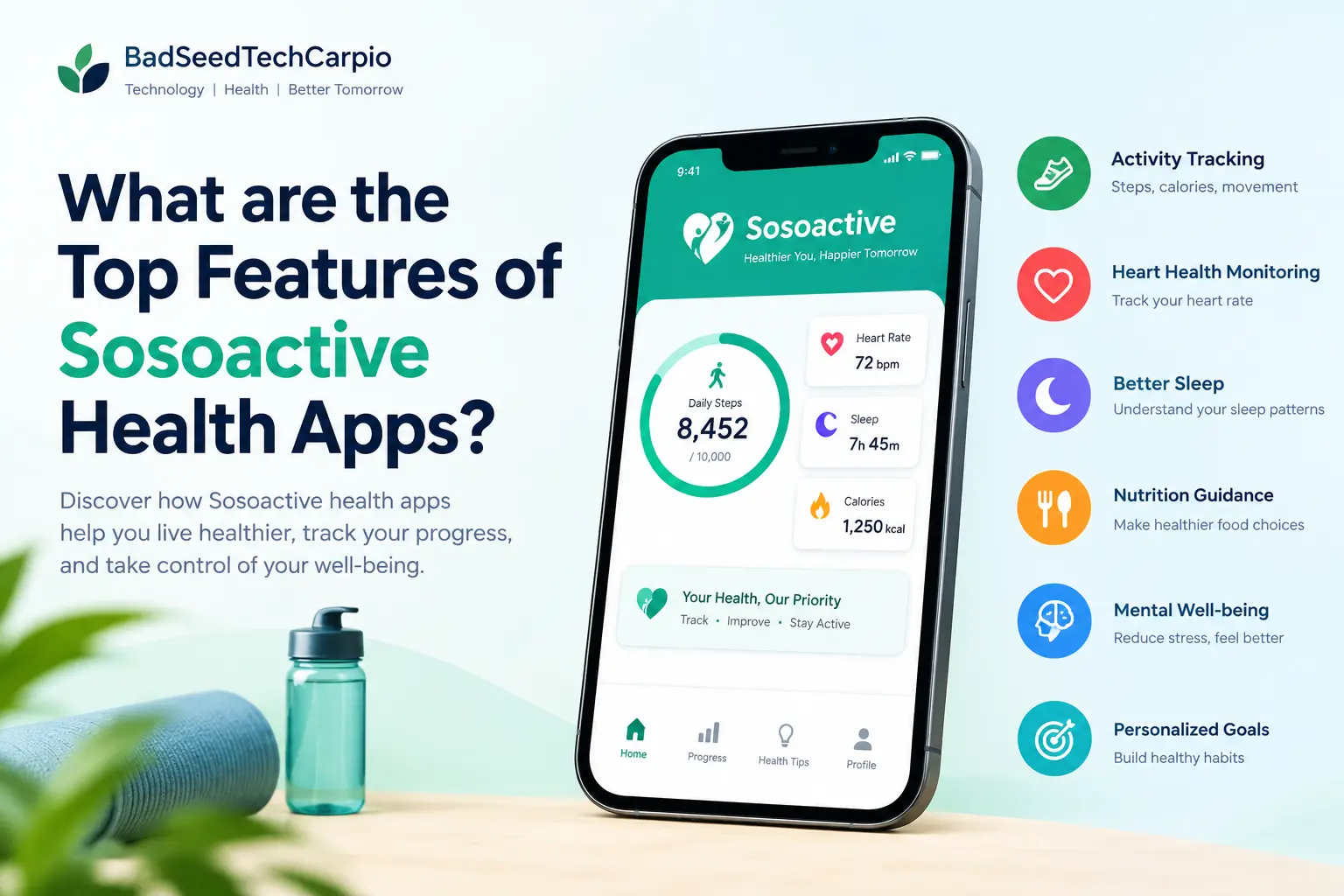
But what are the top features of Sosoactive health apps?
The answer depends on the specific website or application being discussed. The Sosoactive name appears across different online properties, and the features described by one source may not exist on another. The currently accessible Sosoactive website presents health, fitness, mindfulness, and wellness information as part of its broader content offering. A separate, fully documented official health-tracking app with a verified feature list is not clearly established.
Therefore, it is important to distinguish between the health information a platform publishes and the tracking tools offered by a dedicated mobile application.
What Are Sosoactive Health Apps?
Sosoactive health apps is a search term people may use when looking for digital health information, fitness resources, wellness guidance, and related online tools associated with the Sosoactive name.
However, the term should not automatically be interpreted as the name of one verified mobile application.
The currently accessible Sosoactive website covers subjects such as fitness, physical activity, health, mindfulness, and everyday wellness. Readers can explore informational articles to learn about these subjects and discover ideas for building healthier routines.
Dedicated health applications work differently. Depending on the product, they may let users record workouts, monitor steps, review sleep information, log meals, set reminders, or connect compatible wearable devices.
Some platforms combine educational articles with interactive features. Others focus on a single activity, such as meditation, running, nutrition tracking, or sleep management.
When researching Sosoactive health features, begin by checking the exact website or app you are considering. Review its official description, available tools, privacy policy, and supported devices before assuming that it offers specific tracking functions.
This simple step helps readers make informed decisions rather than relying on promotional descriptions or unsupported claims.
1. Easy Access to Health and Wellness Information
One of the most valuable features of a health-focused digital platform is access to understandable information.
Many people want to improve their health but struggle to find guidance that explains everyday wellness topics in simple language. Complicated medical terminology can make it difficult for beginners to understand where to start.
A useful wellness platform addresses this problem by presenting information in a clear, organized, and practical format.
Readers may explore topics such as:
- Healthy daily habits
- Physical activity and exercise
- General nutrition principles
- Stress management
- Mindfulness practices
- Sleep routines
- Personal well-being
- Preventive health awareness
The current Sosoactive website includes health, fitness, and mindfulness content. This makes its informational resources relevant to readers who want to explore general wellness topics.
However, educational articles should not be confused with personalized medical advice. Readers should check the qualifications of the author, the quality of the evidence, and the publication or review date before relying on health information.
Why this feature matters: Accessible information helps people understand their options and make better-informed decisions about their everyday routines.
For example, someone who wants to become more active could read an introductory guide about walking, learn how to build a realistic routine, and discuss any relevant health concerns with a qualified healthcare professional.
2. Fitness Tracking and Physical Activity Monitoring
Fitness tracking is one of the most recognizable features of modern health applications.
A dedicated fitness tracker may record steps, distance, workout duration, movement, and estimated energy expenditure. Some tools can also collect heart-rate measurements through compatible devices.
These features allow users to review their activity and understand how consistently they move throughout the day.
For example, a person may use a fitness application to:
- Record daily walking sessions.
- Monitor running or cycling workouts.
- Track exercise duration.
- Review weekly activity totals.
- Set personal movement goals.
- Compare activity patterns over time.
Some applications use a smartphone’s sensors, while others connect to smartwatches or dedicated fitness bands.
Nevertheless, fitness tracking should be treated as a feature to verify, not an automatically confirmed capability of Sosoactive. The publicly accessible Sosoactive information does not establish that a specific official Sosoactive app records steps, heart rate, or workouts.
If you are comparing a Sosoactive-related service with other fitness tools, check whether the actual product provides automatic tracking, manual activity logging, or educational content only.
Also remember that consumer fitness measurements are estimates. Device placement, sensor quality, movement patterns, and individual differences can affect accuracy.
Fitness data can help people recognize patterns, but it should not replace professional assessment when medical concerns arise.
3. Personalized Health and Fitness Goals
A useful digital wellness tool should help users turn broad intentions into realistic goals.
Many people start a health routine with ambitious plans. They might promise to exercise every day, improve their diet immediately, or completely change their sleep schedule.
Such goals can become difficult to maintain when work, family responsibilities, travel, or unexpected events interfere.
Goal-setting features can make the process more manageable by dividing a large objective into smaller steps.
For example, a compatible health application might allow a user to:
- Set a weekly exercise target.
- Create a walking schedule.
- Establish a regular bedtime.
- Record progress toward a personal goal.
- Review completed activities.
- Adjust targets as circumstances change.
Consider someone who rarely exercises and wants to become more active. Rather than immediately attempting a demanding workout plan, the person could begin with short, comfortable walking sessions and gradually increase activity when appropriate.
This approach can make a new routine easier to maintain.
When assessing Sosoactive health apps, check whether the particular service offers goal-setting tools or simply publishes articles about healthy habits.
Do not assume that an online wellness publication automatically includes personal dashboards, progress charts, or interactive goal management.
The main benefit of goal setting is consistency. A realistic target that fits everyday life is generally more useful than an ambitious target that quickly becomes overwhelming.
4. Daily Habit Building and Routine Management
Healthy living involves more than occasional workouts. Everyday habits influence how people manage movement, rest, meals, and personal well-being.
Habit-building tools can help users establish routines by encouraging them to repeat manageable actions.
Depending on the application, these tools may include habit checklists, reminders, streak counters, completion logs, or weekly summaries.
Common examples include:
- Taking regular movement breaks.
- Drinking water throughout the day.
- Setting aside time for relaxation.
- Following a consistent sleep schedule.
- Planning regular exercise.
- Making time for enjoyable outdoor activities.
For instance, an office worker who spends most of the day sitting could use a reminder tool to stand up and move periodically. A person trying to establish a bedtime routine might create an evening checklist that includes reducing screen use and preparing for the next day.
These examples illustrate how habit tools can work; they are not a claim that Sosoactive provides each feature.
When evaluating digital wellness services, consider whether their approach supports flexible routines rather than creating pressure to maintain perfect streaks.
Missing a day should not make a person feel that the entire effort has failed.
Why this feature matters: Small, repeatable actions can make healthy routines easier to integrate into a busy schedule.
5. Nutrition Education and Food Awareness
Nutrition is another important part of a balanced lifestyle.
People often use health applications to learn about food groups, meal planning, portion awareness, hydration, and general dietary principles.
Some dedicated nutrition applications provide food diaries, calorie estimates, nutrient breakdowns, barcode scanning, or meal-planning tools. Other platforms simply publish educational material.
These are different services, and users should identify which one a platform actually offers.
When exploring nutrition resources, useful topics include:
- Understanding balanced meals.
- Including a variety of foods.
- Learning about dietary fiber.
- Understanding protein, carbohydrates, and fats.
- Developing practical meal-planning habits.
- Recognizing the importance of hydration.
- Evaluating nutrition claims critically.
For example, a person who regularly skips breakfast might explore convenient meal options that suit their preferences, budget, schedule, and nutritional needs.
Someone with a medical condition or a specialized dietary requirement may need individualized advice from a registered dietitian or another qualified healthcare professional.
Also Read: What Is Sosoactive and How Does It Work? A Complete 2026 Guide
6. Sleep Tracking and Rest Awareness
Sleep plays an important role in physical recovery, concentration, mood, and everyday functioning.
For this reason, many people use digital tools to understand their sleep routines.
Dedicated sleep applications may allow users to record bedtime and waking time, maintain a sleep diary, receive reminders, or review estimates generated by compatible wearable devices.
Some tools also present trends that help users notice changes in their schedules.
Potential sleep-related functions to look for in a health application include:
- Sleep schedule logging.
- Bedtime reminders.
- Wake-up alarms.
- Sleep diary entries.
- Weekly sleep summaries.
- Educational material about healthy sleep routines.
A simple sleep diary can be useful even when a platform does not have automatic tracking.
For example, someone who records their bedtime and waking time for several weeks may notice that late-night screen use or an irregular schedule coincides with feeling less rested.
However, a pattern in personal records does not prove a medical cause.
Wearable sleep estimates also have limitations. They should not be treated as equivalent to a clinical sleep assessment.
There is no clear public evidence that the currently accessible Sosoactive website itself provides a sleep-tracking system. Treat sleep monitoring as a useful feature to investigate when comparing dedicated health apps.
If persistent sleep difficulties affect daily life, professional advice may be appropriate.
7. Mindfulness and Stress Management Resources
Physical activity is only one part of overall well-being. Stress management and emotional balance also matter.
Mindfulness resources can introduce people to practices that encourage them to pause, pay attention to the present moment, and respond more thoughtfully to everyday situations.
A dedicated mindfulness application might offer guided meditation, breathing exercises, relaxation sessions, reminders, or progress tracking.
A wellness publication may instead provide articles explaining these practices and discussing how people can incorporate them into daily routines.
The currently accessible Sosoactive website includes mindfulness and general wellness among its subject areas. This supports its relevance as an informational resource, but it does not establish that the site provides a built-in meditation player or a personalized mental wellness dashboard.
Useful mindfulness topics include:
- Taking short breaks during busy days.
- Practicing comfortable, gentle breathing exercises.
- Reducing unnecessary distractions.
- Setting boundaries around work.
- Making time for hobbies and social connections.
- Developing a more consistent relaxation routine.
For example, someone who feels overwhelmed by a busy schedule might try a brief, guided relaxation exercise from a reputable source.
People should choose practices that feel comfortable and stop if an exercise causes distress.
Mindfulness is not a substitute for mental healthcare. Anyone experiencing significant or persistent emotional difficulties should consider speaking with an appropriately qualified professional.
The key benefit of mindfulness resources is that they can make self-care easier to understand and practice.
8. Personalized Recommendations and Content Discovery
Digital platforms often help users discover content related to their interests.
In a health application, recommendations might focus on exercise plans, nutrition articles, meditation sessions, or educational resources.
Depending on the product, recommendations may be based on selected preferences, previous activity, completed lessons, or manually chosen interests.
For example, someone interested in beginner fitness might prefer simple walking guides over advanced strength-training material.
A person who wants to improve their sleep routine might prefer sleep education and relaxation resources.
Relevant recommendations can reduce the time users spend searching for useful information.
However, personalization can work in different ways. Some platforms let users choose topics manually, while others use automated recommendation systems.
The presence of health and fitness categories on a website does not prove that it has an algorithm that analyzes individual behavior.
When evaluating Sosoactive, look for an actual explanation of how its content is organized and whether it offers personalized recommendations.
Ask these questions:
- Can users choose their interests?
- Are recommendations based on clearly explained criteria?
- Can users change their preferences?
- Does the service explain how personal data is used?
- Are recommended health claims supported by reliable evidence?
Personalized content can improve convenience, but relevance alone does not guarantee accuracy.
Users should evaluate health advice carefully, especially when it concerns medication, supplements, symptoms, or treatment decisions.
9. Progress Reports and Health Trend Visualization
Tracking progress can help people understand whether their routines are changing over time.
Some dedicated health applications present information through charts, weekly summaries, activity histories, or personal dashboards.
For example, a fitness application might show the number of recorded workouts completed during the previous month. A sleep diary might summarize bedtime patterns. A habit tracker might display how consistently someone completed a selected activity.
These features help convert individual records into information that is easier to review.
Useful progress-reporting features may include:
- Daily and weekly summaries.
- Historical activity records.
- Visual progress charts.
- Goal completion reports.
- Downloadable data.
- Comparisons between selected time periods.
However, progress should be interpreted in context.
A lower activity total during a busy week does not necessarily mean that a person has failed. Illness, travel, work demands, recovery needs, and other circumstances can affect routines.
Likewise, an increase in a device measurement does not automatically indicate improved health.
There is no verified public feature list establishing that Sosoactive provides its own health dashboards or tracking charts. Readers interested in these capabilities should verify them in the exact application they plan to use.
10. Wearable Device Compatibility
Wearable devices have made personal activity tracking more accessible.
Smartwatches and fitness bands may collect information such as steps, movement, workout duration, heart rate, and estimated sleep patterns.
Some health applications can import these measurements from supported devices or operating-system health services.
When integration is available, users may be able to review information in one place instead of switching between multiple applications.
Potential benefits include:
- Less manual data entry.
- Easier access to activity histories.
- Combined views of supported measurements.
- More convenient workout recording.
- Improved continuity between compatible services.
However, compatibility varies by device, operating system, application version, and country.
Before choosing a health app, check whether it supports your particular smartwatch or fitness band. Also review the permissions required to connect the devices.
Do not assume that a service supports Apple Health, Google Health Connect, Fitbit, Garmin, or any other specific provider unless the service documents that integration.
The same caution applies to Sosoactive. Its publicly accessible informational website does not establish a verified list of compatible wearable devices.
For many users, device integration is useful but not essential. A straightforward application with reliable manual logging may be sufficient for basic personal goals.
11. Health Reminders and Notifications
Reminders can help people remember planned activities and maintain consistent routines.
Depending on the application, reminders may support workout schedules, medication routines, hydration, relaxation breaks, or bedtime preparation.
However, not all reminders have the same purpose or safety requirements.
A reminder to take a short walk is different from a medication alert. Medication schedules must follow the instructions of the prescribing professional or pharmacist, and users should not rely on an unverified wellness app to determine dosage or change treatment.
When reviewing a health application’s reminder system, consider whether it allows users to:
- Choose reminder times.
- Adjust notification frequency.
- Turn reminders off.
- Create recurring schedules.
- Avoid unnecessary interruptions.
- Review important alerts easily.
A good reminder system should support users rather than overwhelm them with notifications.
For example, a person who wants to exercise three times per week might benefit from a calendar reminder before each planned session.
Someone working in a quiet environment may prefer fewer notifications or a daily summary.
There is no confirmed evidence that a specific Sosoactive health app provides these functions. Treat them as evaluation criteria rather than established platform features.
12. User-Friendly Design and Simple Navigation
A health application can contain many features and still be difficult to use.
If users cannot find important information, understand the controls, or record their activities easily, they may stop using the product.
A user-friendly design makes routine tasks straightforward.
Important design qualities include:
- Clear menus and labels.
- Readable text.
- Consistent navigation.
- Simple data-entry forms.
- Accessible color contrast.
- Helpful error messages.
- Compatibility with different screen sizes.
- Clear explanations of permissions.
Beginners may prefer an interface that introduces features gradually instead of displaying too much information at once.
Older adults and people with disabilities may also benefit from larger text, screen-reader compatibility, keyboard navigation, and controls that do not depend entirely on color.
For a web-based wellness resource, the same principles apply to article structure, category navigation, search, and mobile readability.
When evaluating a Sosoactive-related service, inspect the actual website or application on your own device.
Check whether the information is easy to locate, the pages load reliably, and important links work correctly.
A clean interface can improve the user experience, but attractive design alone does not prove that a health application is accurate, secure, or clinically reliable.
13. Educational Content for Different Experience Levels
Not everyone begins their wellness journey with the same level of knowledge.
Some readers are learning about exercise for the first time. Others want to understand nutrition, build a meditation habit, or improve their understanding of digital health technology.
Educational content is more useful when it meets people at their current level.
A well-organized resource may provide:
- Beginner-friendly explanations.
- Practical examples.
- Definitions of unfamiliar terms.
- Step-by-step instructions.
- Links to reliable references.
- More advanced material for experienced readers.
For example, a beginner’s fitness guide should explain how to approach activity gradually and safely. It should not assume that every reader can complete an intense workout.
Similarly, a nutrition article should explain general principles without suggesting that one diet is appropriate for everyone.
The current Sosoactive website offers health, fitness, and mindfulness information within its broader publishing model. Readers can use this type of material to explore subjects and identify questions they may want to research further.
For medical decisions, look for information supported by recognized health organizations, relevant clinical guidelines, or qualified professionals.
Educational content works best when it explains both the potential benefits and the limitations of the advice it presents.
14. Community Support and Social Sharing
Some wellness applications include community features that let users share experiences, participate in group challenges, or exchange encouragement.
When thoughtfully designed, these features can help people feel supported while working toward personal goals.
Examples of possible community functions include:
- Group activity challenges.
- Shared fitness goals.
- Discussion spaces.
- Progress-sharing options.
- Peer encouragement.
- Educational group sessions.
For example, a group of friends might agree to take regular walks and share their completed activities. The social commitment may help participants maintain a routine.
However, community features can also create problems if they encourage unhealthy competition, expose personal information, or spread misleading health advice.
Users should be able to control what they share and avoid disclosing sensitive medical information in public spaces.
A community member’s personal experience should not be treated as proof that a particular treatment works.
It is also important to distinguish between a social platform and an informational website. A site publishing articles does not necessarily have profiles, private messaging, group challenges, or user-generated posts.
Do not assume that Sosoactive provides these tools unless the specific service clearly documents them.
15. Data Privacy and Security
Health-related information can be highly personal.
Depending on the application, collected information might include activity records, sleep patterns, weight entries, dietary logs, symptoms, or other personal details.
Users should understand what data an application collects, how it uses that information, and whether it shares information with outside organizations.
Before signing up for a health service, review its privacy policy and permissions.
Important questions include:
- What personal information does the service collect?
- Does it collect sensitive health information?
- Why is each type of data needed?
- Is information shared with advertisers or other third parties?
- Can users delete their account and records?
- How does the provider protect stored information?
- Does the service explain its data-retention practices?
- Can users limit optional data collection?
Be particularly careful with applications that request unnecessary permissions.
A simple educational website may not need access to your contacts, microphone, precise location, or unrelated files.
Use strong, unique passwords when accounts are required, enable additional security protections when available, and avoid sharing sensitive information through unverified websites.
Do not upload medical records to a platform unless you understand its privacy practices and have a clear reason to do so.
These precautions apply to Sosoactive-related services and other digital health tools alike. A privacy policy should be reviewed directly rather than inferred from a brand name.
16. Accessibility and Mobile Compatibility
Digital wellness resources should be usable by people with different devices, abilities, and levels of technical experience.
Mobile compatibility is especially important because many users access health information while commuting, traveling, or taking a break from work.
A responsive website adjusts to different screen sizes. A mobile application may provide additional functions, but users should verify that it is an authentic application from the intended provider.
Accessibility is equally important.
Helpful features can include:
- Adjustable text size.
- Screen-reader support.
- Clear button labels.
- Simple language.
- Keyboard navigation.
- Sufficient color contrast.
- Alternatives to audio-only instructions.
- Captions for relevant video content.
For instance, a meditation guide with written instructions can be more accessible to someone who cannot comfortably use audio. A workout resource with clear text descriptions may help users understand movements before deciding whether to try them.
When reviewing Sosoactive, assess the actual website or app rather than assuming that mobile compatibility means every accessibility feature is available.
If a mobile application is offered, check its publisher, official website link, permissions, and update history before installing it.
17. Integration With Other Health Services
Some health applications connect with other digital services to help users manage information more conveniently.
Depending on the product, integrations might include calendar applications, wearable devices, health data platforms, or exercise equipment.
Integration can reduce duplicate data entry and make it easier to review information collected by different tools.
However, connections also create privacy considerations.
Before linking accounts, find out what information will be transferred, whether the connection is optional, and how access can be revoked.
Users should also understand that data from different devices may use different measurement methods or definitions.
For example, two devices may calculate activity or sleep estimates differently. Their results may not be directly comparable.
No verified public documentation establishes a specific integration list for a dedicated Sosoactive health app. Readers should not assume that it connects to medical records, fitness devices, calendars, or other applications.
If integration is important to your routine, check the provider’s official compatibility documentation before choosing a service.
18. Cost, Subscription Transparency, and Value
Price is another important consideration when comparing digital health services.
Some applications are free. Others offer optional subscriptions, paid coaching, premium content, or additional tracking features.
The best choice depends on the user’s needs, the reliability of the service, and the value of its features.
Before paying for a health application, check:
- Whether the basic version is free.
- Which features require payment.
- Whether a trial automatically converts into a subscription.
- How billing and cancellation work.
- Whether additional equipment is required.
- Whether the provider offers refunds.
- Whether the advertised features are actually available.
A person who only wants general wellness education may not need a paid subscription.
Someone who wants detailed workout planning or specialized tracking may find a paid product useful, provided its features meet their needs.
It is important not to confuse a free-to-read website with a free mobile application. They are different products, and their pricing arrangements may differ.
The available public information does not establish a verified subscription structure for a dedicated official Sosoactive health app. Check the precise service you intend to use before providing payment details.
19. Evidence-Based Health Guidance
One of the most important qualities of any health-related platform is the quality of its information.
A website can be easy to navigate and a fitness application can produce attractive charts, but neither guarantees that its health recommendations are accurate.
Readers should look for clear sourcing, qualified contributors, appropriate medical review, and explanations of the limits of the information provided.
Useful signs of trustworthy health content include:
- References to reputable health organizations.
- Clear publication or review dates.
- Accurate descriptions of research findings.
- Distinction between evidence and opinion.
- No unsupported promises of cures.
- Transparent information about authors and reviewers.
- Appropriate advice to seek professional care.
Be cautious when a service promises dramatic results, recommends stopping prescribed treatment, or presents a supplement as a guaranteed solution.
Personal testimonials can describe individual experiences, but they cannot establish that a treatment is safe or effective for everyone.
The same standard should apply when reading Sosoactive-related health articles. Verify the claims that matter, particularly those concerning symptoms, medical conditions, supplements, or treatment decisions.
Digital wellness resources can support education and organization. They should not be treated as replacements for qualified medical care.
20. How to Choose the Right Health App for Your Needs
The most useful health application is not necessarily the one with the greatest number of features.
It is the one that fits your goals, works reliably, protects your information, and offers functions you will actually use.
Follow these steps when comparing a Sosoactive-related service with other health and fitness tools.
Step 1: Define Your Main Goal
Decide what you want the service to help you accomplish.
Your goal might be to learn about wellness, record physical activity, improve sleep habits, organize workouts, or practice mindfulness.
Choosing one main purpose helps you avoid paying for unnecessary features.
Step 2: Verify the Exact Product
Search for the official website and, if relevant, the app’s verified listing.
Check the publisher’s name, official links, supported devices, and feature descriptions.
Because the Sosoactive name appears across different websites, verify the domain rather than assuming that similarly named properties are connected.
Step 3: Compare Essential Features
Make a list of the functions you need.
For example, someone who wants to record walking activity may need step tracking, while someone who wants educational resources may only need well-organized articles.
Do not prioritize advanced analytics if simple tracking meets your requirements.
Step 4: Review Privacy and Security
Read the privacy policy and check the requested permissions.
Understand whether the service stores health information, shares data, and allows account deletion.
If these details are unclear, consider another provider.
Step 5: Test Ease of Use
Explore the interface before committing to a paid subscription.
Look for readable text, straightforward navigation, reliable performance, and clear instructions.
If you cannot find the feature you need, the product may not be a good fit.
Step 6: Check Reliability and Evidence
Review the provider’s documentation and look for independent information about the product.
For health guidance, prioritize reliable sources and qualified medical advice.
Do not rely solely on testimonials, promotional claims, or search-engine snippets.
Step 7: Review the Cost
Compare free and paid options.
Check renewal terms, cancellation procedures, and the features included at each price level.
A simple, affordable tool may be more practical than a complicated subscription that you rarely use.
Benefits of Using Digital Health and Wellness Tools
When selected carefully, digital health tools can make everyday wellness routines easier to organize.
Better Awareness of Personal Habits
Activity logs, sleep diaries, and habit checklists may help users notice patterns in their routines.
These records can support more informed discussions with healthcare professionals when appropriate.
More Convenient Organization
Digital calendars, reminders, and progress logs can help people manage exercise sessions and other personal goals.
Easier Access to Educational Resources
Online articles and learning materials allow readers to explore health topics at their own pace.
Support for Consistency
Small goals, reminders, and progress reviews may encourage people to continue routines that fit their lives.
More Informed Questions for Healthcare Professionals
A well-maintained record of symptoms, activity, or sleep patterns may help users describe their experiences during an appointment.
However, these benefits depend on the quality of the tool and how it is used. An application cannot guarantee improved health outcomes simply because it collects data.
Digital resources should complement sensible daily habits and professional care rather than replace them.
Limitations of Health Apps You Should Understand
Digital health applications also have limitations.
Measurements May Be Inaccurate
Consumer devices estimate many measurements. Results can vary with sensor quality, device placement, and recording methods.
Not Every User Needs Every Feature
Detailed dashboards and advanced tracking can be unnecessary for people who only want basic wellness information.
Too Many Notifications Can Become Distracting
Frequent reminders may interrupt work or create pressure to meet arbitrary targets.
Health Information Can Be Misleading
Poorly sourced articles and unsupported claims can encourage unhelpful decisions.
Privacy Practices Differ Between Providers
Some services collect more information than others. Users need to understand the relevant privacy terms and permissions.
Digital Tools Cannot Replace Medical Diagnosis
A fitness score or sleep estimate cannot independently diagnose a condition.
If you have concerning symptoms or need treatment advice, contact a qualified healthcare professional.
Understanding these limitations helps users make more realistic decisions about what digital health tools can accomplish.
Is Sosoactive Worth Exploring for Health and Fitness Information?
Sosoactive may be worth exploring if you are interested in general information about health, fitness, mindfulness, and everyday wellness.
Its currently accessible website presents content across these subjects, making it relevant to readers who want to explore different lifestyle topics.
However, whether it is suitable for your specific needs depends on what you expect from it.
If you want to read educational articles, a publishing website may meet your needs.
If you want automatic step counting, heart-rate measurements, sleep analysis, wearable integration, or a personal health dashboard, verify that the exact product you are considering provides those functions.
The distinction is important because an informational website and a dedicated health-monitoring application serve different purposes.
Before relying on any Sosoactive-branded service, check its official description, privacy policy, contact information, and available features.
You should also verify whether any app claiming to represent the brand is linked from a trustworthy official source.
A careful evaluation is more useful than choosing a platform based only on its name or a long list of advertised capabilities.
Frequently Asked Questions About Sosoactive Health Apps
1. What are the top features of Sosoactive health apps?
The features people commonly look for in health applications include fitness tracking, wellness education, habit building, goal setting, nutrition awareness, sleep logging, mindfulness resources, progress reports, reminders, and privacy controls.
However, these are general digital health features to evaluate, not a verified list of functions available in a single official Sosoactive app.
The currently accessible Sosoactive website publishes content related to health, fitness, and mindfulness. Check the exact service before assuming it includes interactive tracking tools.
2. Is Sosoactive a health and fitness app?
The publicly accessible Sosoactive website presents itself primarily as a digital publishing platform that covers several subjects, including health, fitness, and mindfulness.
A separate official mobile health application with a clearly documented feature list has not been established by the information reviewed for this guide.
Readers should verify the exact product and its publisher before downloading an application or sharing personal information.
3. Can Sosoactive track daily steps?
The available public information does not verify that the currently accessible Sosoactive website includes a step-tracking function.
Dedicated fitness applications may track steps using smartphone sensors or compatible wearable devices.
If step counting is important to you, confirm that the specific application supports it and understand how its measurements are calculated.
4. Does Sosoactive provide personalized health recommendations?
Sosoactive publishes information across health, fitness, and mindfulness topics.
However, the availability of an automated recommendation engine or personalized health plan has not been verified for a dedicated official Sosoactive health app.
Look for a clear explanation of how recommendations are generated and whether they are based on personal data.
5. Can I use health apps to improve my fitness?
Health applications can help people organize workouts, record activities, set goals, and review progress when they provide those functions.
Their usefulness depends on the quality of the application, the accuracy of its measurements, and how consistently you use it.
Choose realistic goals and seek professional advice if you have medical concerns or need a personalized exercise plan.
6. Are health and wellness apps safe to use?
Many digital health tools can be useful, but their safety depends on their design, data practices, and the reliability of their information.
Review the privacy policy, permissions, developer information, and evidence supporting health recommendations.
Avoid treating app-generated scores or automated advice as a substitute for medical diagnosis.
7. Are Sosoactive health apps free?
The available information does not establish a verified pricing structure for a dedicated official Sosoactive health application.
The cost of a website’s content and the cost of a separate mobile application are not necessarily the same.
Check the exact provider’s official information before purchasing a subscription or entering payment details.
8. Can health apps replace doctors?
No. Health applications can help people record information and learn about general wellness, but they cannot replace qualified medical professionals.
Do not use an app alone to diagnose a condition, change prescribed medication, or delay necessary medical care.
9. How can I protect my privacy when using health apps?
Choose services with clear privacy policies, request only necessary permissions, use strong passwords, and avoid sharing sensitive information unnecessarily.
Check whether the service shares data with third parties and whether you can delete your account and records.
These precautions are especially important when an application requests access to health records or wearable-device information.
10. What should I check before downloading a Sosoactive-related app?
Verify the exact domain, developer, official website link, feature list, permissions, privacy policy, and recent updates.
Do not assume that an app is authentic simply because it uses the Sosoactive name.
If the provider’s identity or privacy practices are unclear, avoid submitting sensitive information until you can verify the service.
Conclusion
Digital technology offers many ways to learn about health, organize fitness routines, and develop healthier habits. Useful features may include activity tracking, goal setting, sleep diaries, mindfulness resources, nutrition education, progress reports, reminders, and privacy controls.
However, the most important question is not how many features a platform advertises. It is whether those features are genuinely available, reliable, appropriate for your needs, and supported by transparent information.
Sosoactive’s currently accessible website covers health, fitness, mindfulness, and other informational subjects. That makes it relevant to readers exploring general wellness information, but it does not establish that a single official Sosoactive health app includes every tracking function discussed in this guide.
Before choosing a Sosoactive-related service, verify the exact product, review its privacy practices, and distinguish educational content from interactive health-monitoring tools.
