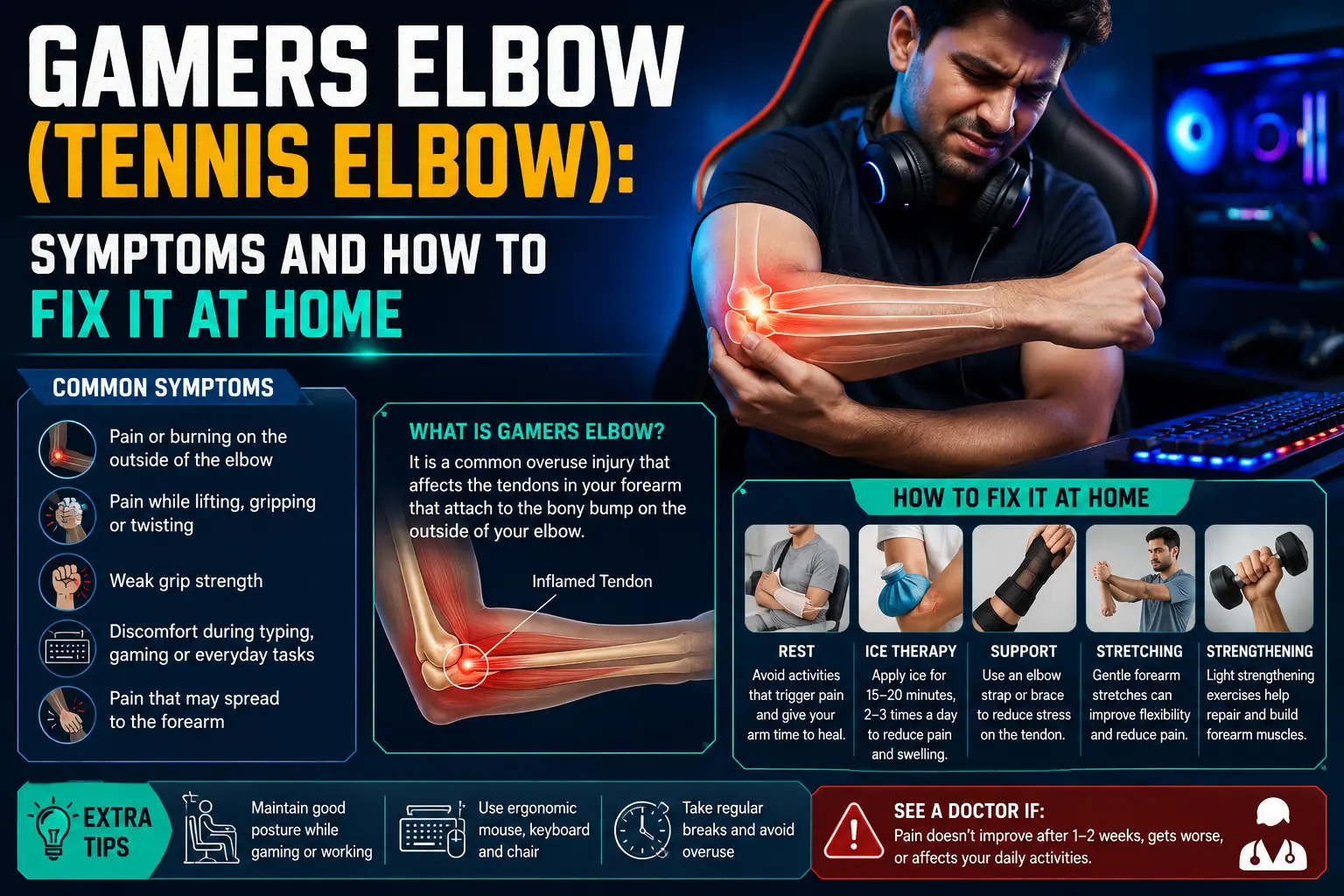
You don’t need to have picked up a tennis racket in your life to develop tennis elbow. If you’ve spent enough hours gripping a mouse, clicking, and flicking your wrist during intense sessions, you can end up with the exact same injury — just with a different name attached: gamers elbow. Physical therapists increasingly use this term, and it’s showing up more often as competitive and casual gaming both trend toward longer, more repetitive sessions. It’s a different injury from the wrist strain we usually cover here — like the kind DeltaHub and the Carpio line are designed to address — but the two often show up together, since both come from the same repetitive gripping and wrist-extension patterns.
Here’s what’s actually happening in your arm, what the research says about treating it at home, and where the line is for seeing an actual doctor.
What’s Actually Going Wrong in Your Arm With Gamers Elbow
The medical name is lateral epicondylitis — inflammation and, in more chronic cases, microscopic tearing of the tendon that connects your forearm muscles to the bony bump on the outside of your elbow (the lateral epicondyle). The specific tendon involved is usually the extensor carpi radialis brevis (ECRB), which runs from that bony point down into your wrist and is responsible for extending your wrist backward and stabilizing it during gripping motions.
Every time you grip a mouse, click a button, or hold tension in your wrist to aim precisely, that tendon is under load. Do that for thousands of repetitions across a long session — and thousands of sessions across months — and the tendon starts breaking down faster than your body can repair it. That’s the core mechanism: tissue damage outpacing tissue healing, not a single injury moment.
Historically, this condition earned its “tennis elbow” name because doctors first noticed the pattern in tennis players using poor backhand technique. But research has made it clear tennis was never really the point — fewer than 10% of tennis elbow cases actually happen in tennis players. It’s fundamentally a repetitive-strain condition, and gaming produces exactly the kind of repetitive gripping and wrist-extension load that causes it.
Why Gamers Specifically Get Gamers Elbow
Gamers elbow tends to differ slightly from the classic tennis-swing version in mechanism, but the outcome is the same tendon under the same kind of chronic stress. A few gaming-specific factors make it worse:
- Sustained low-grade grip tension. Unlike a tennis swing (a burst of force, then recovery), competitive gaming often involves holding tension in the forearm continuously for long stretches — micro-adjustments during aim, constant readiness to click.
- Repetitive clicking at high frequency. Fast-paced games can involve thousands of clicks per session, each one a small extensor contraction.
- Poor wrist positioning. A mouse or keyboard positioned too high, too far away, or at an awkward angle forces the wrist into extension for hours, adding load on top of the repetitive strain itself.
- No recovery windows. Long uninterrupted sessions without breaks don’t give the tendon any chance to recover between load cycles — which is the entire mechanism behind why this becomes a chronic problem instead of a one-off soreness.
If your mouse grip and hand position are part of the problem, it’s worth checking whether your actual mouse shape is contributing — we cover this in detail in our guide to the best ergonomic mouse options for gamers, including grip styles that reduce sustained extensor tension.
Recognizing the Symptoms of Gamers Elbow
Gamers elbow builds gradually, which is exactly why people tend to ignore it until it’s disrupting daily tasks, not just gaming sessions. Common signs include:
- Pain or a burning sensation on the outside of the elbow, sometimes radiating down into the forearm
- Tenderness when pressing directly on the bony point on the outside of the elbow
- Weaker grip strength — struggling with things like shaking hands, turning a doorknob, or lifting a mug
- Pain that worsens with wrist extension or gripping motions, and often eases with rest
- Stiffness in the morning or after periods of inactivity
Doctors sometimes use a few quick clinical tests to confirm this diagnosis — Cozen’s test, Mill’s test, and Maudsley’s test all involve resisting wrist or finger extension while checking for pain at the lateral epicondyle. You won’t need to run these yourself, but if you’re describing symptoms to a doctor, mentioning where exactly the pain triggers (resisted wrist extension specifically) helps them zero in faster.
The Actual Home Treatment Protocol for Gamers Elbow
The encouraging news here: research consistently shows 80-95% of cases resolve with non-surgical treatment, and a large share of that treatment can genuinely happen at home. Here’s what the evidence actually supports, not just generic “rest and ice” advice.
Start With Relative Rest, Not Total Rest
Completely stopping all arm use isn’t necessary or even generally recommended — the goal is reducing the specific repetitive load (long gaming sessions, aggressive clicking) while keeping the arm moving normally otherwise. Cutting session length and adding frequent breaks matters more than avoiding the mouse entirely.
Ice for the Acute Phase
In the first days when pain is sharp and inflammation is active, icing the outside of the elbow for 15-20 minutes a few times a day helps with pain and swelling. This matters most early on — once you’re past the acute phase and into weeks of lingering discomfort, exercise-based treatment does more of the actual work.
NSAIDs for Short-Term Relief
Over-the-counter anti-inflammatories like ibuprofen can reduce pain and swelling in the short term. They’re a symptom-management tool, not a fix for the underlying tendon issue — useful for getting through acute flare-ups, not a long-term strategy.
Eccentric and Isometric Exercise — This Is Where the Real Recovery Happens
This is the part most casual advice skips, and it’s the part with the strongest research behind it. Exercise interventions consistently outperform passive treatments (rest alone, ultrasound, most passive modalities) for actual recovery — a large meta-analysis covering over 2,100 subjects across 30 trials found active exercise approaches produced meaningfully better outcomes than passive ones, even though the individual effect sizes were often modest.
Two specific approaches have the most research behind them:
Eccentric wrist extension exercises — lengthening the extensor tendon under controlled load — are widely used because they encourage tissue remodeling rather than just resting the tendon. A well-known version, the Tyler Twist technique using a flexible rubber bar (a FlexBar), showed strong results in research from the Nicholas Institute of Sports Medicine: measures of strength, pain, and disability all improved significantly more in the group doing FlexBar exercise alongside standard therapy compared to standard therapy alone.
Isometric exercises — holding a static contraction rather than moving through a range — have also shown a genuinely interesting effect: research indicates isometric holds performed above an individual’s pain threshold can reduce pain perception, making them a useful option early in recovery when movement-based exercise is still too aggressive.
A simple, low-equipment starting routine:
- Wrist extensor stretch — extend your arm, gently pull your hand down and toward you with the other hand, hold 15-20 seconds, repeat several times per side.
- Isometric wrist extension — press the back of your hand against a table edge or wall without moving your wrist, hold 10-15 seconds, several reps.
- Eccentric wrist extension (once acute pain has settled) — using a light dumbbell or resistance band, slowly lower your wrist from extended to flexed position under control.
As a general guideline, chronic or longer-standing cases take longer to resolve — up to 8 weeks isn’t unusual — and progression should only continue once you’re managing minimal or no pain at the current level, not before.
Bracing — What Actually Works and What Doesn’t
This is a case where the research contradicts what most people instinctively buy for gamers elbow. Counterforce braces — the strap-style braces worn just below the elbow — have consistently shown real, measurable improvement in pain-free grip strength in multiple studies. Wrist splints, by contrast, have shown little to no measurable improvement in the same studies, despite being a more commonly marketed option. If you’re going to buy a brace, the forearm strap style has the evidence behind it, not a wrist splint.
When to Actually See a Doctor for Gamers Elbow
Home treatment is genuinely effective for the large majority of gamers elbow cases, but a few signs mean it’s time to get it checked professionally rather than continuing to self-manage:
- Pain that hasn’t improved after several weeks of consistent home treatment
- Significant swelling, visible deformity, or inability to move the elbow normally
- Numbness or tingling extending into the hand (this can indicate nerve involvement rather than a pure tendon issue)
- Pain severe enough to interfere with basic daily tasks, not just gaming
A doctor may recommend steroid injections for short-term relief, though these are generally used sparingly since repeated use can actually weaken the tendon attachment over time. Platelet-rich plasma (PRP) injections and extracorporeal shockwave therapy are other options for cases that don’t respond to conservative treatment, though the evidence on these is still developing compared to exercise-based approaches.
Preventing Gamers Elbow From Coming Back
Once you’ve dealt with gamers elbow, preventing a recurrence matters as much as the initial recovery, since the same repetitive load that caused it the first time is still there every time you sit down to play.
The biggest lever is reducing sustained wrist extension and unnecessary grip tension in your actual setup. If your mouse and keyboard positioning force your wrist into extension for hours, that’s compounding load on a tendon that’s already been damaged once. Our complete ergonomic desk setup guide covers the correct desk, chair, and peripheral positioning that takes unnecessary strain off your wrists and forearms in the first place.
It’s also worth reconsidering your mouse grip specifically. We covered the actual clinical research on this in our breakdown of vertical mouse vs. regular mouse — a more neutral forearm position reduces the pronation-related strain that compounds elbow and wrist issues together. And if you’re already noticing early wrist fatigue alongside your elbow symptoms, it’s worth checking our guide on signs you need an ergonomic wrist rest — the wrist and elbow strain patterns from gaming tend to show up together, not in isolation. If you want the full picture on wrist support options, our BadSeed Tech Carpio full guide covers what to look for, and if budget is a concern, we’ve also rounded up the best Carpio alternatives under $20.
Bottom Line
Gamers elbow is a genuine, well-documented overuse injury — not just “sore hands from playing too much” — and the good news is that the majority of cases respond well to non-surgical, largely at-home treatment. Rest reduction, targeted eccentric and isometric exercises, and (if you’re bracing) a counterforce strap rather than a wrist splint make up the evidence-backed core of recovery. Give it the 6-8 weeks it typically needs, don’t push through sharp pain, and fix the setup issues that caused it in the first place — otherwise you’re just treating the same injury on repeat.