Carpal tunnel syndrome might be the most over-diagnosed self-diagnosis in gaming. Ask around any competitive scene and half the players with sore, tingling hands will tell you they “probably have carpal tunnel” — but the actual clinical data tells a more surprising story. One hand-therapy clinic that’s worked specifically with gamers for eight years reported seeing genuine carpal tunnel syndrome in just 1 out of over 2,500 gamer patients.
Nearly everything else that felt like it — the aching, the numbness, the weak grip — turned out to be something else, usually tendon-related overuse, not actual nerve compression.
That doesn’t mean carpal tunnel syndrome (CTS) isn’t real in gamers. It is, and it’s genuinely becoming more common as gaming hours climb and the average gamer’s age creeps into their 30s and 40s. But knowing the difference between “my hands hurt from gaming” and “I have a nerve compression injury that needs medical treatment” matters — because the two need completely different fixes, and treating the wrong one delays getting better.
What Carpal Tunnel Syndrome Actually Is
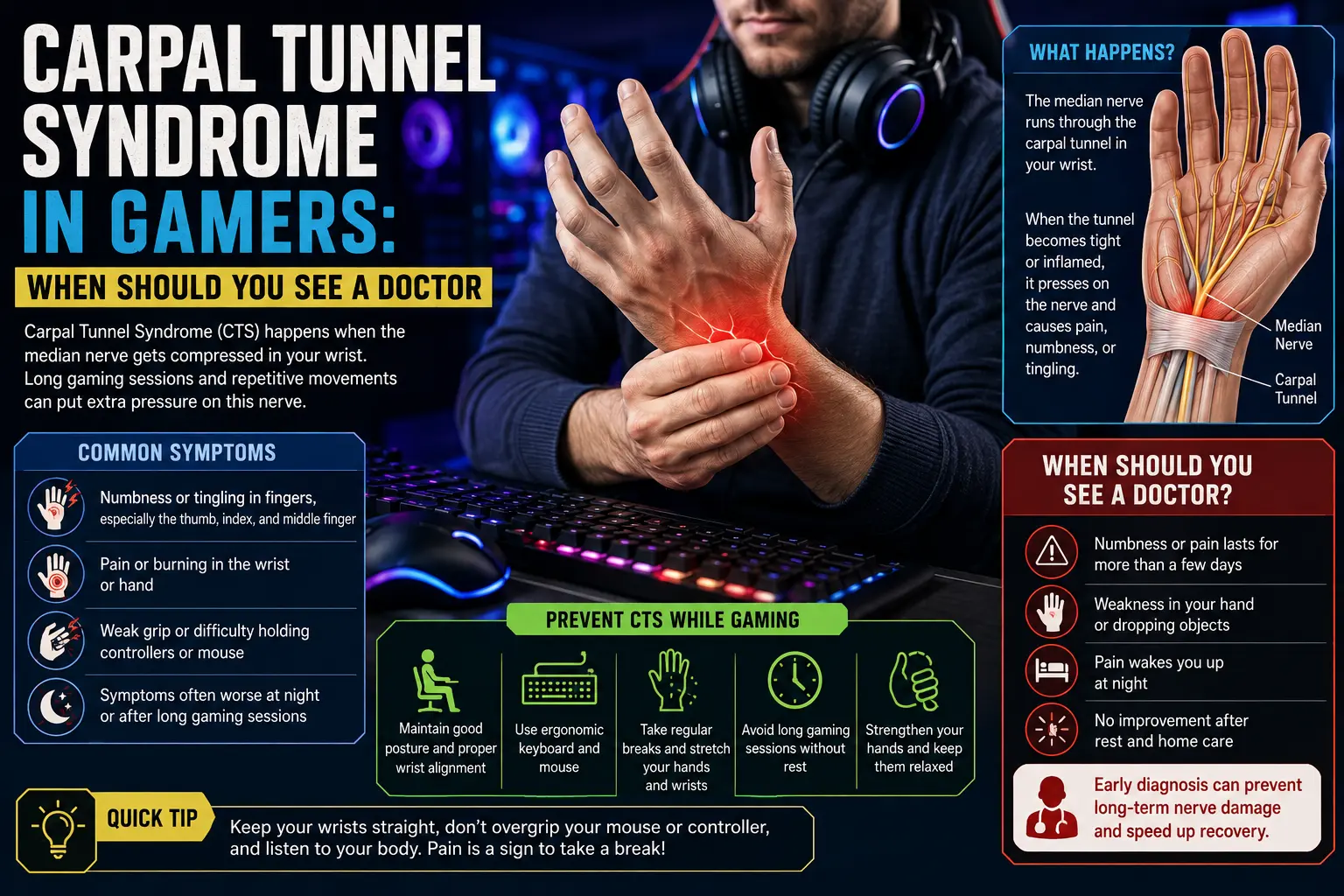
carpal tunnel syndrome CTS happens when the median nerve — which runs from your forearm, through a narrow passageway in your wrist called the carpal tunnel, into your hand — gets compressed. That passageway is formed by wrist bones on one side and a ligament (the transverse carpal ligament) on the other, and anything that swells or narrows that space puts pressure directly on the nerve.
The result is a very specific symptom pattern, and this specificity is actually the most useful diagnostic clue available to you before you ever see a doctor: carpal tunnel syndrome symptoms are confined to the territory the median nerve controls — the thumb, index finger, middle finger, and half of the ring finger.
Pinky-side numbness or tingling is a different nerve entirely (the ulnar nerve, and a different condition called cubital tunnel syndrome). If your symptoms are spread across your whole hand or concentrated on the pinky side, it’s probably not classic carpal tunnel — which, on its own, rules out one of the most common gamer self-diagnoses.
Why Gamers Specifically Are At Risk
Research has started catching up to what gamers have long suspected anecdotally. A 2023 study comparing 95 esports athletes to a control group of 103 non-gamers found that longer competitive gaming careers correlated with higher scores on the Boston Carpal Tunnel Questionnaire — a standard clinical severity scale — and that symptom severity scaled with hours played.
The same research found something practically useful: PC gamers using keyboard and mouse scored worse than console players using controllers with armrests, suggesting the specific hand position and lack of support during PC gaming carries more risk than controller-based play.
The mechanism lines up with what we know about the condition generally. The median nerve is compressed most when the wrist sits in extended or flexed positions — not neutral — and repetitive gripping under that non-neutral position compounds the pressure over time.
Long PC sessions with a wrist bent upward over a keyboard or mouse, especially without support, check every box in that mechanism.
The Symptoms That Actually Point to CTS
Beyond the finger-location pattern above, a few other signs are more specific to genuine nerve compression rather than general fatigue or tendon strain:
- Numbness or tingling that continues after you stop playing, rather than resolving within a few minutes
- Symptoms that wake you up at night or are noticeably worse when you first wake up — this is extremely common with CTS specifically, since many people sleep with wrists flexed
- A weakening grip — dropping the mouse, struggling to hold a controller, or noticing reduced precision that isn’t about skill
- Difficulty with fine motor tasks outside of gaming — buttoning a shirt, picking up small objects, texting
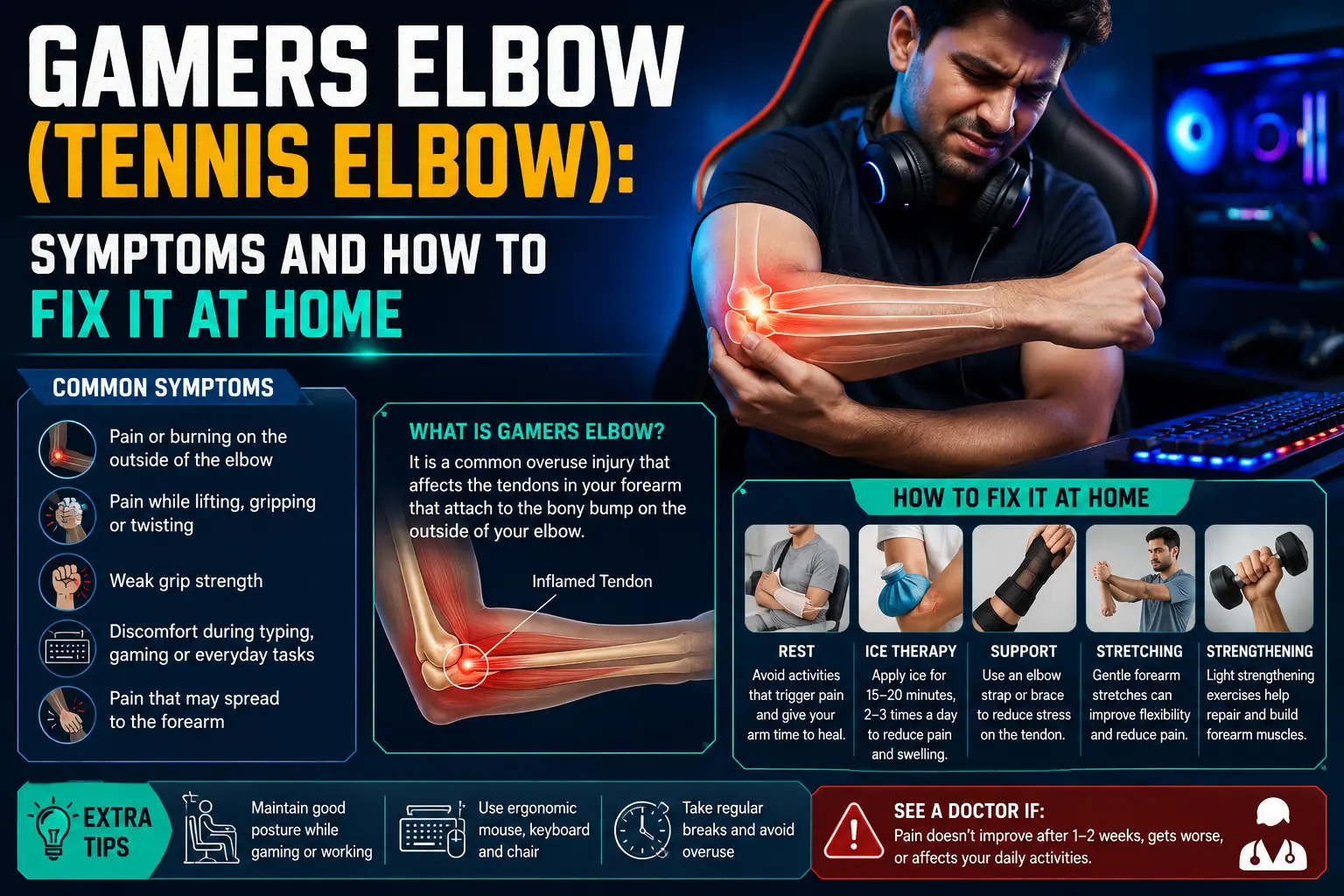
By contrast, soreness that’s diffuse, feels muscular rather than “electric” or tingling, and fully resolves shortly after you stop playing is much more likely to be a tendon or muscle overuse issue — the kind we covered in our breakdown of gamers elbow, which is actually a far more common gaming injury than true carpal tunnel syndrome despite getting less attention online.
When You Should Actually See a Doctor
The clearest, most research-backed guideline is function-based rather than pain-based: if symptoms keep recurring, start lasting beyond your gaming sessions, or begin interfering with sleep or daily tasks, it’s time to get evaluated. A single uncomfortable session after unusually long play isn’t a medical emergency. A pattern that’s building over weeks is worth checking.
More specifically, these signs mean you shouldn’t wait:
- Persistent symptoms beyond two weeks, despite adjusting your setup and taking breaks
- Progressive weakness — this is the clearest sign the condition may be advancing toward nerve damage that becomes harder to reverse the longer it continues
- Sleep disruption more than twice a week from hand numbness or tingling
- Numbness that doesn’t fully go away between gaming sessions, rather than just during them
- Thenar muscle changes — noticeable wasting or flattening of the muscle at the base of your thumb, a sign of more advanced nerve involvement
One more distinction worth knowing: if numbness or tingling comes with paleness, a blue tint, or a cold sensation in the fingers, that combination points toward a blood flow problem rather than nerve compression, and is a reason to seek medical attention more urgently — potentially an ER visit rather than a scheduled doctor’s appointment.
How Doctors Actually Diagnose It
If you do see a doctor, expect a physical exam first — testing sensation in your fingers, checking grip strength, and often performing simple provocation tests (like flexing the wrist to see if it reproduces your symptoms). For confirmation or in ambiguous cases, doctors use nerve conduction studies and electromyography (EMG) — tests that directly measure how well electrical signals travel through the median nerve and whether they’re slowed at the point where it passes through the carpal tunnel. These tests are also useful for ruling out the tendon and muscle conditions that mimic CTS but need different treatment, which matters given how often gaming-related hand pain turns out to be one of those instead.
Treatment: What Actually Helps
The reassuring news is that most cases, especially caught early, respond well to non-surgical treatment.
Splinting is generally the first-line option for mild to moderate symptoms, particularly worn at night since many people unknowingly flex their wrists during sleep, worsening compression exactly when they can’t correct for it. That said, some clinical sources note that long-term, all-day rigid splint use can contribute to muscle deconditioning over time — so night-time or symptom-flare use tends to make more sense than wearing a splint constantly.
Activity modification and ergonomic changes matter, but the research here has an honest catch worth knowing: studies have found that ergonomic equipment or positioning changes alone, without any other intervention, haven’t reliably proven effective at resolving CTS symptoms. What does show better results is combining ergonomic changes with education on proper technique, postural habits, targeted exercise, and consistent break scheduling — the setup change is necessary but not sufficient on its own. If your current setup is part of the problem, our complete ergonomic desk setup guide and our breakdown of ergonomic wrist rests cover the setup half of that equation.
Medication — oral anti-inflammatories or corticosteroid injections — can reduce swelling and provide relief, though steroid injections specifically have been found effective in only around half of patients, with benefits typically lasting just a few months even when they work, and repeat injections in the same joint generally aren’t recommended.
Surgery — carpal tunnel release, which relieves pressure by cutting the ligament that’s compressing the nerve — is reserved for moderate-to-severe cases that haven’t responded to conservative treatment, or for cases with clear progressive nerve damage. It’s a well-established, generally effective procedure when it’s actually needed, which is exactly why catching the condition before it reaches that point through earlier treatment matters.
Reducing Your Risk Going Forward
Since gripping style and wrist position are the biggest levers in gaming-related CTS risk, a few changes make a real, evidence-backed difference: keeping your wrist in a neutral position rather than bent up or down, using proper support so your wrist isn’t unsupported over the edge of a desk, and taking consistent breaks during long sessions rather than pushing through multi-hour blocks.
If your actual mouse or grip style is contributing to wrist positioning problems, our comparison of vertical mouse vs. regular mouse covers the research on which grip changes genuinely reduce strain versus which are mostly marketing.
And if you’re specifically trying to figure out whether wrist support gear would help your particular setup, our guide on the best ergonomic mouse options for gamers is worth a look as well.
Bottom Line
Genuine carpal tunnel syndrome in gamers is real, backed by actual clinical research showing higher symptom scores correlating with more competitive gaming hours — but it’s also less common than the internet’s casual self-diagnosis culture suggests, and it’s frequently confused with tendon-related overuse injuries that need different treatment entirely.
Use the finger-location pattern (thumb, index, middle, half the ring finger — never the pinky) as your first filter, pay attention to whether symptoms persist after you stop playing or disrupt your sleep, and don’t wait out progressive weakness.
Most cases caught early respond well to conservative treatment; the cases that end up needing surgery are usually the ones where symptoms went unaddressed the longest.